
A Chronology of the Indochinese Refugee Movement 1954-1980
Abbreviations:
E&I – Employment and Immigration Canada (Manpower and Immigration’s successor)
DND – The Department of National Defence
UNHCR – The United Nations High Commissioner for Refugees
1954
Capitulation of the French garrison at Dien Bien Phu (May) followed by the Geneva Conference Accords (July) ends French military involvement in Indochina.
1955
Beginning of US involvement in South Vietnam (November) with deployment of military trainers under the Military Advisory Assistance Group (MAAG). Mission is training only.
1961-1964
Steady increase of U.S. military presence in South Vietnam, primarily as trainers/advisers. By July 1964, their numbers reach 21,000.
1964
The Gulf of Tonkin Incident (August), an alleged North Vietnamese attack on US warships, provides rationale to increase US Military involvement.
1965
U.S. Marines land at Danang (March) as the first combat units to deploy to South Vietnam.
1967
By this time, there are 400,000 U.S. troops in Vietnam.
1968
The Tet Offensive (Jan 30, 1968 – Sep 23, 1968), a tactical victory but strategic defeat for the U.S. and South Vietnam. The U.S. begins gradual “de-escalation” and “Vietnamisation” as a preliminary step to withdrawal.
1970
Prince Sihanouk of Cambodia is deposed in U.S.-backed military coup (March). A U.S. and South Vietnamese “incursion” into Cambodia follows to disrupt North Vietnamese supply lines into South. Ongoing massive bombing campaign in eastern Cambodia. The beginning of Cambodian civil war, which culminates with a Khmer Rouge victory.
1973
The Paris Peace Accords (January) end overt U.S. military involvement. U.S. forces leave Vietnam over the following months.
1975
April: The Khmer Rouge and Pathet Lao seize Phnom Penh (Cambodia) and Vientiane (Laos). Saigon falls to communist forces on April 30. Some 130,000 people flee from South Vietnam and are rescued by the U.S. Navy.
In Cambodia, the Khmer Rouge initiate a forced evacuation of the urban population into the countryside, ostensibly to create a new communal agrarian society. Phnom Penh and other towns are left largely empty.
In Laos, impact of the Pathet Lao victory is slower, except for the Hill Tribes (chiefly Hmong), who are accused of collaboration with the U.S.
April: Desperate Vietnamese students from Montreal lobby the federal government to rescue their relatives in Vietnam. The government commits to assist, but few relatives are able to leave Vietnam because of strict government exit controls. Over a two week period in April, before the fall of Saigon, the Canadian Embassy in that city sends “Promise of Visa Letters” to 3,500 heads of family in Vietnam – encompassing approximately 15,000 family members.
April 6: The first group of Indochinese orphans start to arrive in Canada.
April 24: Canada-based staff at the embassy in Saigon are evacuated.
April 30: Saigon falls to North Vietnamese forces. Approximately 140,000 people flee South Vietnam by air and sea to a U.S. Navy evacuation fleet and neighbouring countries.
May 1: Robert Andras, Minister of Manpower and Immigration, announces that, in addition to those Indochinese already sponsored by relatives, Canada will accept 3,000 Vietnamese and Kampuchean refugees without relatives in Canada. Two thousand will be selected from refugees evacuated to United States Refugee Centres and one thousand from other countries.
May: The U.S. moves the refugees to military bases in the continental U.S.A. Canadian officials from Canadian Consulates in Los Angeles and New Orleans, and from Ottawa, accept several thousand from Camp Pendleton, Indian Town Gap, Fort Chafee and Ellis Air Force Base and arrange transport to Canada. The notorious Vietnamese General, Dang Van Quang, arrives in Canada from the U.S., sponsored by family members in Montreal. The resulting controversy dampens public and political support for Vietnamese refugees.
May: In Laos, the U.S. military evacuates Hmong leadership to Thailand and later to the United States. Hmong and other hill tribe members begin fleeing to Thailand.
May: Freighter Trong Xuan escapes Vietnam, crammed with 3,700 refugees and begins to sink some days later. The passengers and crew rescued by the Danish freighter Clara Maersk and are taken to Hong Kong, where those with Canadian relatives (number unknown) are immediately accepted by Canadian visa officers.
May-June: The beginning of “re-education” of members of former South Vietnam’s military and officials. New Economic Zones in the countryside are announced, along with a partial ban on private trade. People start fleeing Vietnam in small boats, beginning the ‘boat people’ phenomenon.
December: Vietnam experiences extreme cold, followed by drought, resulting in a rice shortage. This results in lack of food and economic disruption.
May – December: Thai authorities make repeated efforts to normalize relations with Khmer Rouge regime in Cambodia in order to maintain a buffer with Vietnam. These efforts are met with only limited success.
December: The Pathet Lao proclaim the Lao Popular Democratic Republic. The end of the moderate regime is marked by arrests, repression and establishment of “seminars”, a Lao version of “re-education.” Many urban middle class members flee to Thailand. By 1977, some 10% of the Lao population has fled to Thailand.
May 7-23: A Canadian team arrives in Guam and processes 1,400 Vietnamese refugees who had been evacuated by the U.S. military. Later, Canadian officials from Ottawa and from Canada’s consulates in Los Angeles and New Orleans process thousands more from military bases in the continental United States.
1976
October: 180 residual places in the 3000 Indochinese target announced by Minister Andras in May 1975 are applied to boat people.
November: A group of Cambodian refugees is turned back by Thai authorities at the border and handed over to the Khmer Rouge. It is reported that these refugees are killed in short order.
The Thai military begins providing help to anti-Communist Khmer (Free Khmer) guerillas along the border.
December: Between May 1975 and December 1976, a total of 6,353 Indochinese refugees arrived in Canada, 3,601 in 1975 and 2,752 in 1976. Of these 4,200 were accepted because they had relatives in Canada and 2,300 were accepted as Convention refugees. Officials believe Canada has done its part but will continue to accept “boat people” with relatives in Canada.
By the end of 1976, an estimated 5,619 boat people have arrived in neighbouring Southeast Asian countries.
1977
In Vietnam, 1977 is marked by poor weather and related natural disasters, bad harvests, and economic collapse. The numbers of people fleeing in small boats increases.
July: Border disputes occur between Vietnam and the Khmer Rouge-ruled Cambodia. Similar incursions occur along the border with Thailand.
August: The Canadian government authorizes resettlement in Canada of 450 additional boat people.
October: The ICEM (International Committee on European Migration) opens an operation in Malaysia to support resettlement activities of the U.S., Canada, France and Australia.
December: Heavy fighting between Vietnam and Cambodia; Vietnamese troops advance on Phnom Penh and eventually withdraw. Border disputes and fighting are preceded by the expulsion from Cambodia of large numbers of ethnic Vietnamese.
December: The mayor of Windsor, Ontario, establishes a 13-person committee to help resettle Indochinese refugees in Windsor. Agreement is reached between ICEM Singapore and Canada to book seats on commercial flights. Refugees for Western Canada will fly via the Pacific and those for Eastern Canada across the Atlantic. This doubles the number of seats available to the Canadian program.
December: 21,276 boat people arrive in neighbouring Southeast Asian countries. Indochinese refugees arriving in Canada in 1977 number 854.
1978
January 13: Under a “metered approach” Canada will accept 50 “Small Boat Escapees” families (Program Identifier: SBE) per month. Processing is initially slow. A lack of UN coordination results in several countries processing the same refugees.
January 25: Employment and Immigration Minister Bud Cullen approves a plan to establish a Private Refugee Sponsorship Program. CEIC consults potential sponsoring organizations.
January: Rising tensions between China and Vietnam. The Khmer Rouge are clients of China, while Vietnam is aligned with the Soviet Union.
February: U.S. official reports that Canadian SBE program has had a “multiplier effect” on U.S. decision making.
February: UNHCR implements the ‘Blue Card’ registration system in Malaysia to eliminate processing of the same cases by multiple resettlement countries. The system is introduced in Thailand during the summer of 1978, but for ‘boat people’ only.
March: Hanoi nationalizes the remaining, mainly ethnic Chinese, private businesses, placing increased pressure on this community.
March 14: To simplify procedures, Employment and Immigration Canada proposes a ‘Small Boat Escapee Designated Class’ under Section 6(2) of the 1976 Immigration Act. This evolves into the ‘Indochinese Designated Class’.
April: Ethnic Chinese in northern Vietnam begin ‘returning’ to China: according to the Vietnamese, this is happening voluntarily; according to most returnees, it is by being expelled. China accuses Vietnam of persecuting ethnic Chinese.
July: China cancels all aid to Vietnam, withdraws its remaining technicians, seals the border and claims it has accepted 160,000 ethnic Chinese refugees.
July: The release of the pamphlet “Sponsoring Refugees: Facts for Canadian Groups and Organizations” initiates the refugee sponsorship program. Cabinet instructs CEIC to promote involvement of Canadians in assisting Indochinese refugees. Officials hold briefings across Canada and approaches are made to faith communities, voluntary agencies and Parliamentarians to promote awareness of refugee problem and the new sponsorship program.
20 July: Responding to requests from the UNHCR, the U.S. Government, the Thai Government and interested Canadian groups, Cabinet approves the ‘Thailand Overland Refugees’ program (TOR) for Cambodian and Lao refuges in Thailand. Refugees are to arrive at a ‘metered’ rate of 20 families per month up to an unannounced ceiling of 1,000 persons. Processing of refugees is to commence when a visa office is opened at the Canadian Embassy in Bangkok in November 1978.
September 1978: A freighter, the Southern Cross, chartered by a Hong Kong smuggling syndicate, leaves southern Vietnam with 1,200 refugees on board and eventually beaches on an Indonesian island. Visa officers from the Canadian High Commission in Singapore accept 81 refugees with links to Canada.
September 14: A paper prepared by Employment and Immigration Canada and titled ”Towards an Integrated Canadian Refugee Policy” recommends an “Annual Refugee Plan” as part of the Annual Immigration Levels Plan required by the 1976 Immigration Act, and argues for closer coordination between External Affairs, CIDA and CEIC.
October: The worst flooding in recent Vietnamese history; the 1978 rice crop is short by 7.5 million tonnes, leading to further economic hardship.
October: Detailed instructions outlining selection criteria for ‘Small Boat Escapees’ (SBE) and ‘Thailand Overland Refugees’ (TOR) under the forthcoming ‘Indochinese Designated Class Regulations’ stress the need to keep extended families together.
November 11: Two Canadian officers arrive in Bangkok to establish a visa office at the Canadian Embassy. Their mandate is to process SBE and TOR refugees from camps in Thailand.
November 23: The Edmonton Interfaith Immigration Committee holds a workshop on the sponsorship of Vietnamese refugees.
November: A second freighter, the Hai Hong, again organized by a Hong Kong syndicate, leaves southern Vietnam with 2,500 refugees (mostly ethnic Chinese) on board, and arrives off Port Klang, Malaysia. After an urgent debate within government, Employment and Immigration Minister Bud Cullen announces that Canada will accept 600 refugees from the Hai Hong. Operating in adverse conditions, four federal and Quebec officials accept 603 refugees in three days. Media attention makes this a pivotal event which raises awareness in government, media and the public of the growing Indochinese refugee problem.
November: The Mennonite Central Committee in Canada meets to discuss the government’s new refugee sponsorship program.
December: After months of border skirmishes, Vietnam launches a full-scale invasion of Cambodia. Khmer Rouge resistance proves ineffective.
December 7: The Indochinese Designated Class Regulations are approved by the Governor-in-Council, establishing a simplified basis for selecting and processing Indochinese refugees.
December 11-12: A UNHCR consultation meeting in Geneva draws attention to the growing number Indochinese refugee arrivals in first asylum countries in the region, and the need for more resettlement opportunities.
December 20: The Canadian cabinet decides that 5,000 Indochinese will be admitted under Canada’s first ‘Annual Refugee Plan’. Charter flights are planned to transport these increased numbers to Canada. By the end of 1978, the number of boat people arriving in Southeast Asia totals 106,489. Refugees arrived in Canada in 1978 total 1,944 including 604 from the Hai Hong.
From 1975 to 1978, the total number of Indochinese refugees resettled in Canada was 9,151.
1979
February: The Sino-Vietnamese War. China describes the fighting as “punishment” imposed on an erring “younger brother” for invading Cambodia. The “Punishment” fails to result in Vietnam withdrawing from Cambodia.
March: The Mennonite Central Committee (MCC) signs a Sponsorship Master Agreement with Employment and Immigration Canada, which simplifies sponsorship procedures for its congregations. Other churches follow quickly. Canadian visa officers in Hong Kong, Bangkok and Malaysia put thousands of refugees in process to meet the target established under the Annual Refugee Plan.
China announces phased withdrawal of forces from northern Vietnam.
April to June: There is a dramatic increase in boat arrivals in countries surrounding the South China Sea: from 26,602 in April, to 51,139 in May, to 56,941 in June. The number of ethnic Chinese arriving in China reaches 250,000. Evidence grows that the Vietnamese authorities are actively facilitating the departure of boats, large and small, filled with ‘class enemies’ and ethnic minorities – especially Chinese.
April – May: The flood of Cambodian refugees into Thailand begins, and the Khmer Rouge are forced out of food producing areas within Cambodia. The numbers increase with the realization that insufficient rice has been planted to sustain the population.
May: A ‘Matching Centre’ is established at Canadian immigration headquarters to pair refugees with sponsors and to destine unsponsored refugees to communities across Canada.
May 22: Canadian federal election. No political party wins a majority of the seats in the House of Commons, but Joe Clark’s Progressive Conservatives form a minority Government.
June 4: The Clark Government is sworn in. Ron Atkey becomes Minister of Employment and Immigration, while Flora MacDonald becomes Secretary of State for External Affairs. Both become very active in the Indochina file.
June 18: The federal government announces an increase of its annual target for Indochinese refugees from 5,000 to 8,000, and asks the voluntary sector to sponsor an additional 4,000 refugees under the new ‘Private Refugee Sponsorship Program’.
June 8 – 12: The Thai military forcibly repatriates some 42,000 Cambodian refugees.
June 28: Mennonite, Christian Reformed, Lutheran and Presbyterian Churches submit 388 sponsorships for 1,604 Indochinese refugees.
June 24: Operation Lifeline founding meeting is hosted by Professor Howard Adelman of York University. Ontario region officials of CEIC acquaint participants with the sponsorship program.
June 27: Ottawa Mayor Marion Dewar meets with community leaders and decides to take half of the government’s June 18 commitment of 8,000 persons – hence ‘Project 4000’.
Late June: Thailand, Malaysia, Indonesia, the Philippines and Singapore announce they have “reached the limit of their endurance and decided that they would not accept any new arrivals.” Indochinese Refugee arrivals in Canada from January 1 to June 10 were 4,319.
July 12: The City of Ottawa’s ‘Project 4000’ is launched at a Lansdowne Park Rally on July 16.
Cabinet decides to accept 60,000 refugees over three years. Before the announcement, the number is reduced to 50,000. Immigration Minister Atkey launches a regular newsletter on the Indochinese refugee program.
July 18: Ministers Flora MacDonald and Ron Atkey announce that Canada will resettle 50,000 Indochinese by the end of 1980. They announce a “matching formula” whereby the Government will accept one refugee for each refugee who is privately sponsored. The 50,000 comprises the 8,000 announced in June; 21,000 sponsored by private groups; and the matching 21,000 government assisted refugees.
July 20 – 21: With the principle of “first asylum” under threat, the United Nations hosts a conference in Geneva to consider the problem of Indochinese refugees. The Geneva Conference averts the immediate crisis and concludes with a three way international understanding between countries of origin, countries of first asylum and countries of resettlement
1. ASEAN countries will continue to provide temporary asylum;
2. Vietnam will try to prevent illegal departures and promote orderly departures;
3. Developed countries will accelerate rate of third country resettlement. The above regional and international consensus lasts into the late 1980s.
At Geneva, Foreign Minister Flora MacDonald announces that Canada will accept 50,000 refugees.
International resettlement of Indochinese, which had amounted to around 9,000 per month in the first half of 1979, rose to 25,000 for the latter half of the year.
July 25: The establishment of the Refugee Task Force at Employment and Immigration Headquarters, to coordinate Indochinese refugee program.
July 31: 3,800 refugees are sponsored by 747 sponsorship groups in Canada.
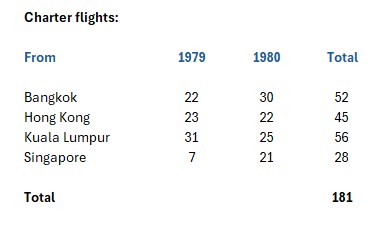
July: The Canadian Government charters 76 flights to transport 15,800 refugees by the end of 1979. The monthly rate of arrival increases from 1,000 to 3,000, and then to 5,000.
July: The Departments of National Defence and Employment and Immigration establish ‘Staging Areas’ (reception centres) at Canadian Forces Bases at Longue Pointe (Montreal) and Greisbach Barracks (Edmonton), to receive arriving refugees.
July 27 – August 26: The Hong Kong airlift. In response to pressing demands for immediate action and because of a lack of available commercial aircraft, CEIC arranges for 11 charter flights with Department of National Defence aircraft to transport refugees from Hong Kong. This allows time to reinforce the visa offices in Singapore and Bangkok, and to build inventories of travel ready refugees to fill commercial charters in the fall of 1979 and into 1980.
August: The Canadian team in Singapore shifts its focus to the growing refugee population in Indonesia. By the fall, the visa office in Singapore is coordinating airlifts out of Kuala Lumpur and Singapore. In Geneva, Canada participates in negotiating and joining the Disembarkation Resettlement Offers (Disero) scheme to facilitate rapid resettlement of refugees rescued by ships of countries that do not resettle refugees.
August 8: The first charter flight arrives at Longue Pointe, Montreal.
August 14: The first charter flight arrives at Griesbach Barracks, Edmonton.
August 30: The matching system is re-designed to allow the Matching Centre to handle 5,000 arriving refugees a month and to match 80% of these with sponsors.
September, 21: By this time, 17,147 refugees have been sponsored by 3,122 sponsorship groups in Canada.
October-November: Between 600,000 and 800,000 starving Cambodian refugees arrive on the Thai border, setting off a new humanitarian crisis.
November 29: The government target of 21,000 privately sponsored refugees is exceeded, as 4,622 groups sponsor 25,059 individuals.
November 13: Cabinet considers the implications of sponsorships exceeding the 21,000 target. It decides it will no longer match each privately sponsored refugee with a Government Assisted Refugee, and will subtract one government refugee for each sponsored refugee over 21,000 to maintain the 50,000 ceiling. The savings will be applied to Cambodian relief.
December 5: Immigration Minister Atkey and Foreign Minister Flora MacDonald announce the Cabinet decision at a breakfast meeting of sponsorship movement leaders. The reaction is negative.
December 13: The minority Government of Prime Minister Joe Clark loses a confidence vote in the House of Commons. A general election is called for February 1980.
Indochinese refugee arrivals in Canada by year’s end:
Privately sponsored 8,211;
Relative sponsored 615;
Government assisted 10,043.
TOTAL 23,583
1980
January 4: A total of 33,114 refugees are sponsored by 6,003 private sponsors in Canada.
February 8: $1.3 million is allocated to cover the administrative costs of organizations coordinating sponsorship activities (Indochinese Resettlement Grants Program) and to top up the Immigrant Settlement Assistance Program for agencies providing direct assistance of refugees.
February 16: Joe Clark’s Progressive Conservatives lose the election to Pierre Trudeau’s Liberals.
March 3: The Trudeau Liberal Government takes office. Lloyd Axworthy becomes the Minister of Employment and Immigration.
April 2: Minister Axworthy announces that 10,000 additional Government Assisted Refugees will be accepted by the end of 1980, bringing the total 1979-80 target for Indochinese refugees to 60,000.
July: Thai authorities open the Phanat Nikhom camp as a central processing center for Cambodians under consideration for third country resettlement.
December 8: Flight 181, the final charter of the program, arrives from Bangkok at Longue Pointe, Quebec, carrying the last of 60,049 refugees. The symbolic 60,000th refugee is a Cambodian destined, along with his family, to a sponsoring church in Goderich, Ontario.
From 1979 to 1980, the Canadian Indochinese Refugee program:
Privately Sponsored: 32,281 (53.8%)
Sponsored by relatives: 1,790 (3%)
Government Assisted: 25,978 (44.2%)
Total: 60,049
Sponsorships: By the end of 1980, 7,675 sponsorships had been filed by private sponsors for 39,904 refuges – some of whom would arrive in 1981.
An international Effort: Between July 1979 and July 1982, more than 20 countries, led by the United States, Canada, France and Australia, resettled 623,800 Indochinese refugees.
In 1986, the UN HIGH Commission for Refugees awarded the Nansen Medal to the people of Canada “in recognition of their essential and constant contribution to the cause of refugees within their country and around the world”
Source of statistics:
Employment and Immigration Canada: The Indochinese Refugees: the Canadian Response, 1979 and 1980 (1981, Department of Supply and Services)
Minister Ronald Atkey, Minister of Employment and Immigration: Indochinese Refugee Newsletters Vols. 1 and 2.
Chronology compiled by Robert Shalka and Mike Molloy, Canadian Immigration Historical Society. Comments, corrections and additions welcome.