
Don’t Take the Boats
– René Bersma
Introduction and Preparation
The past and the future surround us as we progress through the ages. One has to be alert to keep our perspective and choose our direction wisely. I could not have had any idea of the path which would change the course of my life between December 1978 and July 1982. Many years have passed, and not having had access to reports and other relevant documents, I have relied mainly on my memory to recall events of 45 years ago; the reader will excuse my use of anecdotes, but they were part of the atmosphere in which I lived. In January 1981 I started keeping a diary which made it easier to refer to correct dates and events. I also used permits issued by the Vietnamese, my old passports containing entry and departure stamps from Vietnam. There were even a few menus of the Doc Lap Hotel. Beside the 13 visits to Vietnam, references are made to my 17 selection visits to the Thai Refugee camps (Nonghkhai six times, Ubol and Songkhla four times, Surin, Buriram and Aranyaprathet once each), especially the first two years of my positing. And I spent six multiple-night unscheduled visits to the Bangkok Nursing Home.
Report
1. My involvement with Vietnam was entirely accidental. Our generation still remembers the Vietnam War, especially the conflict’s last 10 years. I did not know about the history of this Asian country. While serving in The Hague in early 1975 as a junior visa officer, I met my first Vietnamese. He had been in The Netherlands on an exchange program for a few years and met the qualifications for admission to Canada. It was a straightforward interview, and Vietnam was not mentioned. Saigon had not fallen yet.
2. Upon return to Ottawa in the summer of 1977 for a headquarters assignment, I spent the first 15 months dealing with Western European immigration issues. By December 1978, it became apparent that I would be posted during the following cycle to Hong Kong, where the large volume of Vietnamese family sponsorships would be processed, pending an agreement allowing us to interview applicants in Vietnam. That same month, I focussed on the scope of the posting by preparing myself as well as possible and decided that a private beginner’s course in Mandarin would be useful. Many boat people, the hot news item of 1978, were Sino-Vietnamese, and I structured the course’s vocabulary around essential immigration questions such as family relations, work history and health issues. That academic adventure may have lasted only 10 lessons, the vocabulary learned provided enough confidence to conduct a simple interview.
3. Proof of my newly acquired language skills came at a reception at the Peoples’ Republic of China’s (PRC’s) embassy in Ottawa in April 1979; an official was quite willing to tell me in Mandarin that his family remained in China, I understood about 90 percent of his story and he about the same of my answers. Disconcerting was a sudden click from his vest pocket after a few minutes, like the sound a recorder makes when the tape runs out. He left the conversation abruptly but came back a minute later to continue the conversation as if nothing had happened. More importantly, the knowledge of Mandarin would prove useful in interviewing applicants of Chinese origin in Ho Chi Minh City and in eventual interviews in the PRC itself.
4. Three months earlier, in January 1979, I was transferred to the Asia and Pacific bureau, where I had operational responsibility for immigration program delivery from Vietnam, the People’s Republic of China, Hong Kong (then, still a British Crown Colony), Macao (still Portuguese) and Taiwan. Under the stewardship of Ernest Allen, I was tasked with replying to a large volume of letters of representation from the sizeable Vietnamese diaspora in Canada at that time.1 The relationship with Ernest was very good, and we had many talks preparing me for the upcoming posting. One such topic involved the Vietnamese refusal to allow Canadian immigration officers to conduct interviews inside Vietnam: my suggestion of a secondment of a Canadian officer to the UNHCR office in Vietnam was well received by senior management but rejected by the UNHCR. Our interpretation of “using the good offices of the UNHCR”, a phrase much bandied about at that time, did not include the right to interview prospective immigrants by non-Canadian officials, as established by law. There was also a concern about the issuance and legal value of thousands of promise-of-visa letters (PVLs) issued in April 1975 on the initiative of the manager of the Canadian visa office in Hong Kong. This well-meant gesture was grossly abused: one immigrant in Canada listed no less than 95 relatives. Another mentioned the names of his parents, “and five brothers and sisters”. Also, after 30 April 1975, many Saigonese destroyed any documents or evidence of communications which might link them to another country, as such information could cause them to be considered negatively by the new regime.
5. Unfortunately, a brief war broke out between Vietnam and China in January 1979, and the department decided to send the 5,500 dormant Vietnamese files to the recently opened immigration office in Bangkok and run the prospective program from there. As a consequence, my posting destination changed from Hong Kong to Bangkok. At that time, the short Vietnam-China war was explained in the news as a conflict about a border, involving a few meters here and there. In the three years that I spent working on the Vietnamese family reunification program, it became clear that Vietnam’s conflict with the PRC was most likely the retaliatory result of the Vietnamese incursion into Cambodia near the end of 1978. That earlier conflict occurred to protect Vietnamese citizens living in Cambodia, who were being targeted by the Khmer Rouge. Norodom Sihanouk had friends in Beijing, and, in fact, the PRC was the only country with which Khmer Rouge had friendly relations. The limited skirmishes on Vietnam’s border ended in a stalemate.
6. In preparation for my departure for Bangkok, I spent the last 13 mornings in Ottawa, from 15 May to 1 June 1979, at Berlitz to take private lessons in conversational Vietnamese. There was no text book available, and that allowed me to tailor the course to my operational requirements. The results were reassuring, enough to conduct interviews. My Berlitz certificate for Vietnamese course and letter from C. Estirac-Rateau, Director, dated 1 June 1979, specified that I had gained a vocabulary of 2,000 words, could read Vietnamese newspapers and conduct conversations and interviews in that language.2
7. At this point, it became essential to learn a bit more about the history of Vietnam. The country experienced tenuous relations with its neighbours: China to the north and the Khmers and Siamese to the west for most of the past millennium. The Vietnamese themselves had not always been united either, split into three parts known as Tonkin, Annam and Cochin. In 1885, the French took control of the three parts of Vietnam. Cambodia and Laos were incorporated eight years later to “create” French Indochina. France imported Chinese labourers from Hunan, which was under French rule at the time. The Vietnamese people did not appreciate this initiative, as the newcomers did not integrate well. The French allowed the Chinese to keep their language, culture and education. They settled mainly in Saigon’s Cholon district and in the northern harbour city of Haiphong.
8. During World War II, the Vietnamese suffered badly from the Japanese occupation, and after the war ended, the country underwent a brief spell under the Kuo Min Tang (Nationalist Chinese) while it was torn apart domestically by various factions claiming the leadership. Ho Chí Minh proclaimed the independence of the entirety of Vietnam on 2 September 1945. The French came back in the fall of 1945 to take over from the Chinese nationalists and left in 1954 after their defeat at Dien Bien Phu. A Korea-like situation was created at the 17th parallel: in the north, the Socialist Republic of Vietnam with Hanoi as capital, and the Republic of Vietnam in the south, with its government in Saigon. The first “boat movement” of sorts ensued, as an estimated one million non-Communists left the north in boats for resettlement in the south (mainly in Saigon’s wards 1, 2 and 3), and approximately 100,000 Ho Chi Minh sympathisers left over land to the northern republic. The Americans, worried about the domino theory (of countries falling under communist influence and then rule), entered the scene to back up the southern government, and left after the fall of Saigon in 1975. The north won and the two Vietnams created in 1954 were reunited. Many in the South did not welcome the stringent communist government, especially the Chinese community, and fled the country by boat. This outflow rapidly turned into a huge movement by 1978 involving ethnic Vietnamese as well, and which caused so much distress and death on the South China Sea.
9. Canada’s response to this crisis is described in Running on Empty, Canada and the Indochinese Refugees 1975-19803, a vivid account by Canadian immigration officials sent to Southeast Asia to process Indochinese “displaced” persons (or “ICDP”, as the program was then called). Canadian visa offices in Singapore, Hong Kong and Manila dealt with boat people arrivals, while the office in Bangkok opened in 1978 to process both boat arrivals in Thailand and Indochinese people fleeing overland from Vietnam, Laos and Cambodia to refugee camps in Thailand.
Bangkok
10. I landed in Bangkok at the beginning of July, and spent that evening with Murray Oppertshauser, the officer-in-charge, and Robert Shalka, whom I had met two years earlier in Stuttgart. What I remember most vividly was my introduction to Mekong Coke—Mekong being Thailand’s premier liquor. Branded as a whiskey, it is more like rum, and hence, the local version of a rum and coke mixed drink.
11. After two days in the office getting to know the local immigration staff, which was competent, hospitable and friendly, Robert Shalka and I left Bangkok by a Deutsche Bahn-type overnight train for a three-day processing visit to the refugee camp next to Ubol Ratchathani in Eastern Thailand. That city is near the borders with both Laos and Cambodia (in Thai, Ubol is pronounced Ubon). The train made several stops, and thus, sleeping proved impossible. We reached Ubol at 6 a.m.
Ubol Ratchathani
12. This trip was an excellent introduction to my next three years. Beside kick-starting the Vietnam program, I was expected to participate in the main aspect of the immigration program in Bangkok: to process applications from displaced persons. It was an eye opener: working under a corrugated aluminium roof, with files sticking to hands and lower arms. Many of the persons seeking refuge at the camp were persons of Chinese origin from the Lao city of Pakse on the Mekong River, 140 km north of Ubol. It was quite easy, apparently, to cross into Thailand. There also were Khmers and Vietnamese who had arrived from Cambodia. The languages studied prior to my arrival in Southeast Asia proved very useful, as it helped break the ice at the beginning of the interviews. In any event, there always seemed to be sufficient numbers of camp residents who spoke English or French to serve as translators for the Canadian, American and Australian teams processing applicants. These positions were sought after, as we generally gave application forms to these interpreters at the end of our visits, having experienced their language skills. As for the skills, and especially motivation, of the applicants, I was reminded of John Le Carré’s The Honourable Schoolboy, especially as to what the Khmers endured under Pol Pot’s regime of horror. We drew up extensive family trees, up to three degrees (parents, siblings, cousins, nephews, nieces, grand-parents, children and grandchildren, and their approximate ages- by year of the Chinese zodiac: birthdays as such, were often unknown).
13. The first impressions of the refugee camp were surprising. The camp almost looked like a functioning large rural village. Our visit was well organised by the UNHCR representative. There were many handicrafts for sale, from straw rice baskets, the type Buddhist monks carry when begging, with names in Thai, Western alphabet or Chinese characters woven into the material, to polished Buddhist statues sculpted of soft stone, elaborate trimmings for sarongs, and personalized silver napkin rings, supposedly made by the camp’s residents. It seems unlikely in retrospect that all these items were produced in the camp, but in the understanding that they were, purchasing a few trinkets was a gesture to keep the artists busy.
14. When ordering our breakfast at the hotel, we were amazed that beside the coffee we ordered, there was also a cup of tea served with it. The next morning, Robert and I ordered the same breakfast with tea rather than coffee, and got two cups of tea. Our third and final morning of this trip we ordered breakfast without any drink, and ended up with nothing. Robert and I returned to Bangkok in time for me to pack up files to take to Vietnam.
In the Lion’s Den
15. On Thursday morning, 12 July 1979, I boarded Air France flight 174 at Bangkok’s Don Muang airport and arrived only one hour later at Tan Son Nhat, Ho Chi Minh City’s airport. I remember feeling very apprehensive. With some trepidation and yet a sense of purpose I stepped onto the tarmac of a place that dominated the news for well over a decade. Messrs. Nguyen Phi Tuyen and Quach Thanh Long of the Foreign Affairs Department (SNV) provided a polite welcome in English and drove me to the Doc Lap Hotel (formerly known as the Caravelle) to check in and bring me to the SNV office on Alexandre de Rhodes Street to discuss the parameters and expectations of my visit. Mr. Tuyen was the official in charge, and Mr Long the day-to-day contact person. I walked back from the SNV office to the hotel to get a sense of the city. There was a church—the Notre-Dame of Saigon—and a lot of hustle-and-bustle and bicycles. Many young kids shouted “Liên Xô!” (L-yen So) at me. I soon found out that the expression meant a less-than-endearing word for Soviet (Russian!), the new masters of Vietnam. I guess for many people, I looked like a Russian, being white and taller, and Russians were the latest foreigners.
16. In preparation for this long-expected visit, the SNV had collected a number of persons from a list that had been handed to the Vietnamese government in Hanoi in 1976 by Joyce Cavanagh-Wood. On 23 March 1979, Canadian visa officer Ben Smith had made a first attempt to interview in Ho Chi Minh City, three-and-a-half months earlier, but there was no record of the visit. If applicants had been accepted and medical exams were done, they may have been sent to the visa office in Hong Kong.
17. Ah yes, Friday the 13th! Interviews were conducted in my hotel room. An interpreter had been assigned by the SNV via the Saigon Tourist Office, located right next to the Caravelle. A number of operational problems arose. It soon became obvious the beginning would be slow, as our immigration application forms (the IMM8s) had to be completed for our clients. Another problem surfaced when I realized there was no telephone connection with the outside world. I would have to establish telex links through the UNHCR or Air France to contact our embassy in Thailand.
18. Then there was a really unforeseen legal problem: through the passage of time, sponsorships signed in 1975 under the 1952 Immigration Act for parents and unmarried siblings under the age of 21, had transfigured effectively into Family Class parents with Assisted Relative siblings over the age of 21, some now married, to be considered under the new 1976 Act, implemented in 1978. Fortunately, Ernest Allen raised this matter with urgency in Ottawa upon my return to Bangkok from Vietnam, and the answer was that each case could be considered on its merit, in other words, use your judgment. There were further problems, in that a number of sponsors in Canada were children of well-to-do families (who had been able to pay for their studies abroad), and some of their parents being sponsored were sent into “re-education camps”, and therefore unavailable for their interviews. The Vietnamese euphemism was that the addresses on our list were not correct. Also, health conditions were far from perfect, with many persons suffering from tuberculosis, which would prohibit their admission to Canada. This would become a major problem. Last, but not least, there were Chinese women, not on our list, with young children. They had valid Family Class sponsorships from their husbands, boat people, who had recently applied for their wife and child(ren) on becoming landed immigrants in Canada. I could not legally refuse valid P-1 (high-priority) cases, and there was a genuine effort by the SNV to produce more ethnic Vietnamese from our lists. However, I may have appeared to be compromised by being complicit in a covert Vietnamese policy of ethnic cleansing. On the other hand, not taking these high-priority wives and small children would have forced them to flee by boat, and my conscience would have allowed that even less. In short, 13 July 1979 was a highly charged inaugural day for our immigration program in Vietnam.
19. While I was quite prepared to work long hours my interpreter, (who had a good knowledge of English) decided on his own to send applicants home at 4 p.m. I thought he had left the room to call the next candidates for interview. My reaction was swift. A frank discussion ensued with the director of the tourist office who had worked in East Germany on a debt-program exchange (for assistance to Vietnam, some citizens were sent to Eastern European countries to work in lieu of monetary repayment of Vietnamese state debts). His staff did not need to know my displeasure, so I told him in German, that I alone, and neither the SNV nor the Saigon Tourist Office, was responsible for all aspects of the Canadian immigration program. On Saturday 14 July, a new interpreter, Ms. Ngoc, appeared. She was excellent with the clients and worked diligently on the application for. She would become one of three pillars of Team Canada.
20. The French Consulate General had heard of my arrival. The consul general’s secretary was the spouse of the director of the now-defunct but then-large French chemical and pharmaceutical company Rhône-Poulenc, which was active in Vietnam. She invited me for dinner on Sunday. It was very interesting as members of the UNHCR office just outside Ho Chi Minh City (hereafter referred to as HCMV) and other French non-officials gathered there informally every Sunday evening for pasta dinners, even when the hosts were absent. These meetings would prove informative about recent developments in Vietnam. For example, Cécile had been the French Ambassador’s secretary in Phnom Penh on 15 April 1975, when the Khmer Rouge took control of the Cambodian capital. Many Cambodians fled Phnom Penh across the nearest border to Vietnam in the east. Others, from Siem Reap fled to the north into Thailand to camps in Ubol Ratchathani, Surin and Buri Ram, and those from Battambang and Poipet, the latter on the border, found refuge across the western border in Aranyaprathet.
21. The following week went by with mixed success: on some days there were 60 applicants; on other days only 40. Chinese applicants averaged about 30 percent of the workload. On Wednesday evening, 18 July— the day before the arrival of the weekly Air France flight, the only window to the outside world for HCMV—I organised a dinner for Vietnamese officials involved in our program. This event helped to build a relationship based on trust. A program-related after-dinner speech in Vietnamese was translated into English by our interpreter: that way it was possible to maintain control. That afternoon, prior to the dinner, I briefly visited the small museum of the Revolution on Le Loi Boulevard, close to the hotel, and I noticed some slogans of Ho Chi Minh, such as: “the demand for freedom to leave the country” (from the French). I thought this was a beautiful quote, which fit right into our program. After that line caused a stir at my dinner speech, I went briefly to the museum the following day and found the list of quotes had been removed.
22. That Saturday, I was invited to accompany a UNHCR official residing in Thu Duc, 15 km east of HCMV, to Vung Tau, a town on the coast from where many Vietnamese started their dangerous boat journeys. That trip required requesting a last-minute travel permit from the SNV, which it reluctantly granted. The flat countryside was similar to Thailand. We shared lunch at a local restaurant in Vung Tau with thousands of flies. On the way back, we stopped at Long Thanh, a town with a market where one could get excellent long an fruit, which is similar to a lychee).
23. The next day, Sunday, after working on the week’s files, there was the evening get-together at the Rhône-Poulenc residence. The Air France director, Jacques Léger, was there with his wife Isabelle, along with some champagne that had arrived with Thursday’s Air France flight. Feeling ultra-French, some of the gentlemen tried unsuccessfully to open the bottles with a sword, with shards of glass strewn all over the floor. One person there was Arno, a German who had stayed behind since 1975 to look after (and live in) the German Embassy building across from the airport. For four years he had performed janitorial duties to keep the unused building in shape. Someone had discovered that my birthday was coming up in two days, and they presented me with a fascinating book, L’Histoire du Vietnam by Philippe Devillers, which had a prophetic quote in the introduction. “I had the privilege of being in Vietnam during these first years of the program and found myself in a position from which a complete overview was possible, and where information from all sources converged. I was able to know almost all the major protagonists in the affair, and determine the components of the game. Above all, I experienced the atmosphere.”4
24. On Monday morning, the SNV came to the hotel during an early interview to explain in a friendly manner to me that I should not take “holidays” during my stay: I was there to interview. By Wednesday evening, we had issued over 300 medical instructions to successful applicants for exams at the Dr. Calmette Hospital. After the second Wednesday dinner, it was time to prepare for the flight home.
25. Another Vietnamese official to whom I was introduced was Mr. Nguyen van Nam, who was the head of security for HCMV. An unusual relationship grew out of this meeting. In the past, he had been involved in films for the Viet Cong, and had developed a friendship with a Japanese producer called Makino. He was not fluent, but had notions of Japanese, and could write the Japanese katakana script. When he discovered I spoke Japanese, he wished to practise speaking in that language whenever we met, probably not to the liking of his staff. Through my sister-in-law, who was active in the Japanese film industry, I later found out that Makino-san had passed away, and I advised Mr. Nam. He was very grateful that I had made an effort to find out. As we were constantly watched and bugged, he overheard that I had invited some of my new UNHCR and French friends to have dinner at La Bibliothèque, a restaurant run by Madame Dai, a senator in the former government. He advised me, quite out of the blue, that I should not go there that evening, as there would be a security raid. Note taken. Three years later, at my farewell dinner on 30 June 1982, he wrote a touching good-bye letter, in Japanese. I learned that he was shot two days later in front of his house.
26. Taking everything into consideration, it had been a very successful first visit. I had made essential contacts, identified many problems, of which some needed to be reconsidered carefully to see in what way the program could be streamlined. The concept of Canada providing lists based on Priority One cases would be maintained, and I would type the list in alphabetical order. The Vietnamese officials’ request that I arrange the list by district would be too much of a challenge, as some of the sponsorships lacked the district identifier. After the reception of favourable medical results lists sent via Air France to Bangkok (and from there to Singapore, where Dr David Holbrook was the chief medical officer) we would issue the visas and send them to the SNV office for distribution.
27. The Air France Director, Jacques Léger, insisted I relax by myself after these two hectic weeks in Vietnam on the second floor of the Boeing 747, and I was given a window seat in the very front row. What happened 10 minutes after take-off was one of the most frightful and unforgettable moments of my life: the flight was gaining height through the clouds when we got caught in a thunderstorm. As that seat’s window was slightly slanted, I saw a lightning bolt strike and jolt the nose cone of the airplane, literally feet ahead of me. The engine stopped and we started a free fall. Kudos to the captain who managed to re-start the motors just in time, as the ground below had become quite visible, and pulled us out of the dive. If there is such a thing as a divine moment, this moment exemplified the eventual success after a shaky start.
Between Vietnam Visits
28. Back in Bangkok, the applications completed in HCMV were put into process rather smoothly, given that there were already several thousand Thai refugee camp files. Kudos to Murray Oppertshauser and the registry staff, led by Khun Achara and Khun Uraiwan.
29. In an attempt to achieve Canada’s humanitarian program, immigration officials from both the inland Canada Immigration Centres and the foreign service were sent to the region in order to fill a quota of 50,000 (later 60,000) refugees, not including the Vietnamese Family Reunification program. Bill Lundy was posted to Bangkok as the second-in-command officer, with my position being designated as second-in-command (Vietnam).

30. A few days later, I joined a refugee selection trip to Nongkhai Camp. Nongkhai, an eight-hour drive by station wagon and 600 km north of Bangkok, is a major city on the Mekong River, across from Vientiane, Laos’s commercial capital. There were rumours that some of the applicants crossed the river by ferry for the interview; others may have been Thai Chu, the Chinese ethnic minority, who took advantage of poor control measures in this facility, which was much larger than Ubol. On visits to Nongkai, our team stayed at a hotel in Udon Thani, 60 km south of Nongkhai.
31. Another trip was to Songkhla, a city on the Thailand-Malaysia border, where a camp of boat people was located on a beach. After the day’s interviews, I sometimes stayed behind and played beach soccer with the Vietnamese young men, and by the end of 1979, most ofwhom were not of Chinese extraction. This provided me with an opportunity to expand my understanding of why these people decided to take the boats, their planning, overcoming the dangers to finally reach a south-east Asian shore, where they were not made to feel welcome. There are plenty of harrowing situations where boat people were pushed out from the shores, with catastrophic consequences. There was a couple, the Kammingas, religious missionaries who were church-sponsoring Vietnamese willing to convert to Christianity. I wondered how that worked out once the refugees got their visas. No follow-up research seems to have been conducted.
32. On another visit to Nongkhai, Frank Seegers from CIC Hamilton and foreign service officer Leo Verboven travelled with me. We discussed the procedures and the list with the UNHCR official, in this case Dutchman Robert Saaf. One disconcerting element of the accessible, open air interview spaces in the camps was that dozens of camp residents would crowd around us to find out whether we would have new or special interview instructions. This time, they had bad luck as all four of us decided to discuss the parameters of the visit in Dutch. They couldn’t figure out why Canadians spoke a language other than French or English. One of those rare gotcha moments. On that specific camp-trip, MP Robert Wenman and Murray Oppertshauser came from Bangkok for a one-day visit.
Second Vietnam Visit, Solving Medical Problems
33. On return from Nongkhai, the first medical results from my Vietnam trip had begun to trickle in. A large number of cases was “furthered”, meaning more medical information was required, likely the confirmation of tuberculosis, which could spell the end of the program at the first hurdle. I contacted Dr Holbrook right away and urged him to accompany me to HCMV on my next trip, scheduled for 20 September. Fortunately, he was able to liberate himself for that week.
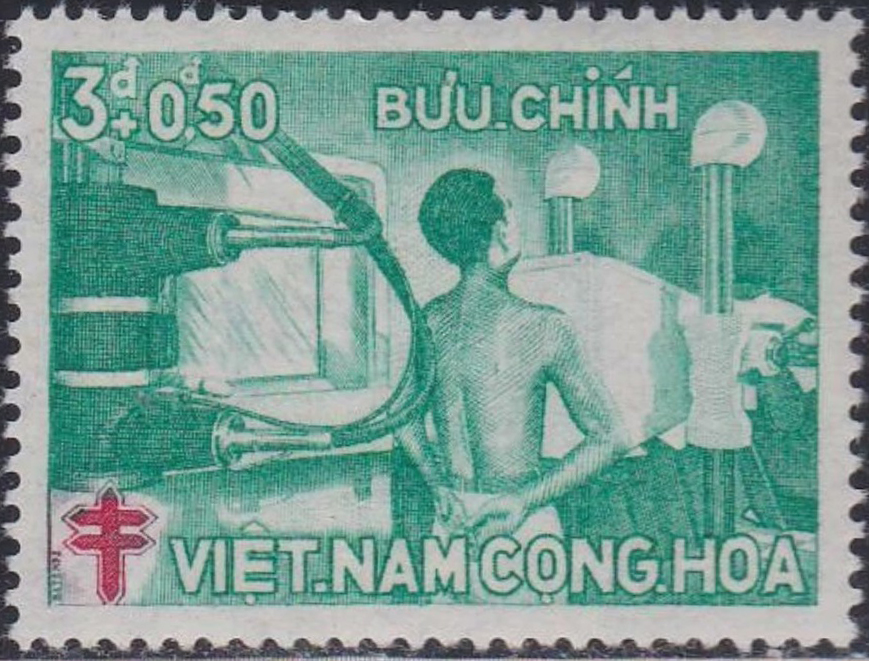
Image provided by the author
34. Upon arrival, we checked into the Doc Lap hotel, and called at the Saigon Tourist Office for our interpreter, Ms. Ngoc, and had the customary meeting in the afternoon at the SNV. The essential point was that Dr. Holbrook meet his colleagues of the Dr. Calmette Hospital in HCMV, designated for our medical examinations. The major problem consisted of a high number of tuberculosis cases. Persons suffering from this disease were prohibited by law from admission to Canada, both under the 1952 Act 5(b), and the 1976 Act 19(1)(a)(i) and (ii).5 Tuberculosis was a known medical problem in Vietnam. In 1960, the government of the Republic of South Vietnam issued a special postal stamp dedicated to the fight against that disease with a surtax to specifically fund tuberculosis relief.
35. As a non-medic, I understand here are three types of tuberculosis: inactive, active non-contagious and active contagious. HCMV hospitals still used the old 10 cm X-rays, whereas Canada’s medical services had started to use 42 cm X-rays in the 1970’s which were less intrusive and provided a much better image of the lungs. The long and short of this aspect of the medical problem was that the Dr. Calmette could process this 42 cm size, but the specific plates were not available in Vietnam. The matter was discussed and the solution I suggested was accepted: I would bring hundreds of 42 cm X-rays sent from Singapore to Bangkok with me each visit into Vietnam until a simpler method could be found. These boxes of 42 cm X-rays were very heavy and unwieldy. Dr. Holbrook and his associates also offered to forward quantities of anti-tuberculosis medication to the Dr. Calmette hospital to be used for Canada-bound cases. This would render the inactive non-contagious cases safe enough to allow us to issue IMM1000 immigrant visas or minister’s permits.
36. It seemed that the solution to each problem opened up new problems, like a regenerating hydra. For example, the Vietnamese would allow a family household to come forward for interview, but only after that family (unit under one roof: including married children living there) applied for and obtained an exit visa. A condition was that the house would revert to the state. It was expected that the family presented for interview would be accepted by us, but in many families, there was a member suffering from tuberculosis. In fact, the cook of a restaurant I frequented was member of a family on the list, was medically examined and found to have tuberculosis, a sobering thought. Splitting a family and letting the healthy go forward (if the other members qualified) was an option, but the applicant staying behind would have to vacate the house. In the case of the cook, now in his early twenties and married with a family since the original sponsorship in 1975, this would become a humanitarian problem. Fortunately, the solution in the case of the cook was solved within a few months thanks to Dr. Holbrook’s offer. David Holbrook was a very humane person and many Vietnamese families owe their Canadian visas to his understanding and decisions. He noticed that Ms. Ngoc, our interpreter, looked frail and prescribed medication for her. We travelled to Vung Tau on Sunday, 23 September, to show him the origin of the medical cases he examined in Singapore. On an unrelated subject, that Sunday was the last time that I met Arno, the caretaker of the former German Embassy building. He was to be repatriated to Germany that week.
37. Yet a new problem surfaced. According to the Canadian Immigration Act, immigrants needed to be in possession of valid passports. The Vietnamese refused to issue passports, providing xuât canh, “exit permits”, instead. These documents did not allow the bearer to return to Vietnam, which meant that immigrants from Vietnam who had entered Canada through fraud could not be extradited back to that country. The matter was raised with officials in Ottawa, who allowed the exit permit to be added to list of permissible travel documents.
38. There was a corollary to this situation, as the French had been lax about providing the Chinese they brought in with valid identity documents. Typically, the Chinese in Vietnam had never opted for Vietnamese citizenship—most had entered Vietnam before 1940, well before the proclamation of independence by Ho Chi Minh in 1945 and the establishment of the PRC four years later. The flight in 1949 of the Kuo Ming Tang and Chiang Kai Chek to Taiwan, recognized by Western countries as the legitimate representative of China until the mid-seventies, the Sino-Viets in 1979 could no longer avail themselves of either PRC, Taiwanese or Vietnamese passports. During the 1970s, President Nixon’s ping-pong diplomacy had led to the recognition of the PRC as sole representative of China, at the expense of Taiwan, which was expelled from the United Nations, and derecognized by most countries in the West, including Canada. Taiwan lost its representation in the new Vietnam, which left the Chinese community flailing to obtain Taiwanese passports, which were no longer recognised by Canada. The Vietnamese relented by issuing exit visas to the Sino-Viet community, as that document did not grant readmission to Vietnam.
39. The interviewing aspect on this trip was much like in the July visit: cases from our list were generously interspersed with Sino-Viet spouses of landed boat people. The Vietnamese complained about my lists as they were not prepared in their alphabetical order, which was a spurious allegation. Their own telephone directory was set up in the way that we presented our list, which had been alphabetically produced by the family name of the head of the family (eg, Huynh, Nguyen, Truong, Vu). The Vietnamese wished a list which would see Nguyen van Nam be preceded by Vu Hoang, because the H comes before the N. It is analogous to us producing a telephone book by first name, Larry Carroll and Michael Molloy appearing before Peter Duschinsky and René Bersma. I told them that they could figure out my list perfectly well. They also complained about our lists of names as there were no names of Chinese families on them. This was technically correct, because we had presented lists for people who had been legally in the pipeline for nearly five years, on the basis of sponsorships submitted in 1975, when there were no Sino-Viets in Canada. In any event, their concern was invalid, as we also agreed to see all spouses of the Sino-Viet community whose sponsorships had been accepted by CICs across Canada. This was precisely why it was necessary that one person dedicated to the program from the Canadian side neutralize any attempt by the Vietnamese to change conditions unilaterally.
Hanoi Fireworks
40. Dr. Holbrooke, having inspected the situation on the ground in person, passed a number of cases, with these results filtering into Bangkok in the week of 15 October. On Thursday, 25 October, the first 55 immigrant visas were sent via Air France to the SNV in HCMV. The next visit was prepared for 8 November, and a visa request was submitted to the Vietnamese Embassy in Bangkok, where the two persons in charge of the Consular section, Mr. Tan and Ms. Ninh, were becoming faces rather than names.
41. On Friday, 2 November, we received an urgent message from the UNHCR office in Hanoi that I travel there urgently as the Vietnamese government was very frustrated by the lack of developments in the program. Of some potential importance, on Sunday, 4 November, the world geopolitical landscape took a hit when Iranian students attacked the U.S. embassy in Tehran and took the staff hostage. The matter was urgently discussed the following day at the U.N.—the only country supporting Iran turned out to be Vietnam (!). On 7 November, I picked up my visa, worked on a presentation for Hanoi, and left on the next day, feeling apprehensive as to whether my diplomatic status would be respected after the U.N. vote.
42. A staff member of the UNHCR picked me up at Hanoi’s Noi Bai airport and brought me to their office. The road into the city was fascinating. We crossed the Red River over an antiquated very narrow bridge used by trains (the single track in the middle left just enough space for pedestrians, and at their peril at that), cars, carts, cyclists and pedestrians. William Clarance was in charge of the UNHCR office, seconded by Tonne Verwey. Unbelievably, Verwey and I had met 20 years earlier playing a soccer game between our two elementary schools in our native Rotterdam. They briefed me on the anger expressed by Vu Hoang, the Foreign Ministry’s Consular Affairs Director, and the likelihood that the program would be ditched. The discussion with William Clarance was frank, diplomatically speaking, with a sense of foreboding for the next day’s meeting. Also present was a Vietnamese interpreter working with the UNHCR, although I did not understand why he was a (silent) partner to this English-language conversation, other than the obvious: report the contents to his government. After the meeting, Mr. Verwey invited me for dinner at his apartment. He was married to a Rwandan widow, Imaculée, with two children. His staff-quarters on the fourth floor of a dark building was about two kilometers from downtown, through unlit streets with mainly unlit bicycles, mopeds and army trucks to contend with. Army trucks used only one light, which made it dangerous as they could be mistaken for mopeds.
43. A room was reserved in the Hoa Binh (“Peace”) Hotel, an antiquated building constructed around the beginning of the last century with pretentious French imperial opulence. The hotel served as the base, the residence, and offices, of many foreign diplomats, who covered their beds to allow them to work during the day. There was no running water, so people brushed their teeth with beer or wine. An unknown diplomat I encountered in the corridor kindly a provided me with a bottle of beer.
44. The latter part of the evening was spent back in the hotel preparing for the meeting with Vu Hoang, knowing that the fate and legitimate hopes and rights of thousands of people were hanging on a very fragile thread. I had brought a large sheet of paper with felt-tip markers with me, and set out to explain the workings of the Canadian immigration program in a flow chart.
45. Breakfast was served in a restaurant hall with rats on tables feasting on left overs, rats in curtains and rats roaming the floors, their presence being made known by guests stamping their feet as the vermin came too close. Nobody seemed particularly troubled by their presence. After some bread and coffee, I made my way to the UNHCR office, from where Messrs. Clarance, Verwey and the interpreter would come along. Tonne Verwey presence was especially a boost for my morale.
46. The meeting began with a barrage of banalities that Canada was not serious, wasting time, all that which was expected following the briefing the previous day. Mr. Hoang spoke in Vietnamese with a government interpreter translating his words in French. When he had finished his monologue, I looked at Hoang and asked what happened to the first batch of 55 visas to HCMV’s SNV that we had sent two weeks earlier. The interpreter did not translate what I said, leaving out the 55 visas part. I interrupted him straight away with “ça n’est pas ce que je disais” whereupon a total pall of silence and shock descended on the meeting for perhaps 10-15 seconds, which seemed like an eternity. They were caught off guard by me interrupting the interpreter, the fact that I obviously understood enough Vietnamese, and, more importantly, they were seemingly unaware that the visas had been sent. Losing face is about the worst that can happen in Asia, let alone to a senior official, and it just did. The presence of William Clarance and Verwey probably prevented a show of anger. Mr. Hoang asked the interpreter to phone HCMV about this development, and the man came back a few minutes later to confirm what I had said. I again asked Mr. Hoang, who spoke fluent French (and in future meetings, he and I would converse without interpreters), why there was this delay. Air France had confirmed Tuesday morning (6 November) before I left Bangkok that there were no people from our lists scheduled to leave on the Air France flight from HCMV this very day, Thursday, 8 November, and so there would now be at least three weeks between receipt of visas and departures.
47. It was that very key moment that in the void of silence, that the initiative in the discussion and, by extension, the program, was seized. I showed Mr. Hoang the processing diagram, and he suddenly recognized that he faced an immigration expert rather than just a diplomat. European diplomats, not versed in immigration legislation, were sent to Hanoi to report on political events, but at that time, in 1979, there was no European immigration legislation or policy. Europe had been a colonizing and emigration continent, their respective diplomats would meet Vu Hoang with requests about a particular person or other consular matters, receive demands in return, which would then have to be reported back to their respective capitals for a fitting reply or action, and, if there was one, months later there would be the follow-up meeting in Hanoi. In contrast, here was a Canadian immigration official who could make legal decisions and explain policy, answer questions on the spot and openly showed how the system worked. Mr. Hoang’s attitude changed by about 180 degrees and the meeting actually ended quite amicably. I asked Mr. Hoang that I should like to go to HCMV to resume my interviews as early as tomorrow, there was no reason to wait. He agreed, and through the good offices of the UNHCR, I gave my passport so that the necessary travel permit for me could be issued immediately. Clarance heaved a big sigh of relief; I probably did, too, back in his office. The permit was received on Saturday 10 November, allowing me to fly to HCMV to resume the interviews.
48. I used the rest of the day to explore Hanoi. The city in 1979 had remnants of French colonial architecture; most of it was dilapidated because the years of conflict had prevented the buildings’ upkeep. There was an attractive rectangular lake in the middle of the city with its Mot Cot pagoda. Years ago, in 1968, I had watched a snake charmer in New Delhi. In Hanoi I chanced upon a snake seller (for food), sitting on the ground with one foot holding down six crawling snakes. It seemed surreal. I totally forgot that in my country of birth, eating smoked eel, a water snake after all, was a highly prized delicacy which I had often enjoyed- so why not these snakes? The Temple of Literature was an oasis of peace with its walled garden and calligraphy collection. The minder accompanying me wondered why I could read Chinese. I sidestepped his question by answering that his great grandparents wrote and read only those very characters 60 years ago, and a nucleus of Vietnamese academics should retain a knowledge of their previous and precious script, otherwise the meaning of family or historical documents still to be uncovered, now that the wars were over, would be lost. I returned to the UNHCR office to thank them for their assistance and presence at the meeting. As I left the office with Tonne and two other officers, we joined an impromptu soccer game on the square in front of the office: ‘us’ vs them. To hell with protocol, we won 9–3. It was a fitting end to a good day.
Ho Chi Minh City, Third Visit
49. When travelling on Air Vietnam’s Tupolev fleet, one needed to suppress the occasional gulp. Of my six trips from Noi Bai, Hanoi to Tan Son Nhat, HCMV, “my” plane visibly had a flat tire on two occasions. And, this 11 November was the first of those two. Furthermore, moments after take-off, a white mist filled the entire cabin, which would only disappear several minutes after take-off. The first experience was particularly scary, but in hindsight we arrived safely every time.
50. I had greeted the hostess in Vietnamese upon boarding and she was surprised; Russians had a stand-offish reputation and did not communicate openly with Vietnamese, and certainly not in Vietnamese. And so, she made sure I had plenty of tea during the flight. Before landing she even gave me a handful of paper-wrapped candies to relieve the air pressure on the ears and I put those sweets in my pocket. When leaving the aircraft, I thanked her for the service and she smilingly gave me some more sweets. After registering at the hotel, I left my suitcases in the room and put my collection of sweets on the black commode and went for a walk. When I returned an hour or so later, I opened the door to my room and, reflecting in the sun, noticed a large dark red stain on the commode where I had placed the sweets. To my surprise that stain consisted of a lot of red ants, red dead ants, that is, that had fatally feasted on the sweets. It was of course a shock to see that even red ants, the strongest of the species, had been killed by those sweets instantaneously and fortunately I had not felt the urge to indulge. What stuff were these candies made of? Surely that lady on the plane didn’t have the intention to kill me. You never know. I never tried Vietnamese candies after that.
51. Vu Hoang’s group had done its work, and the SNV had arranged for an interpreter through the Saigon Tourist Office. Ms. Ngoc was on another assignment, and Ms. Thu Ha was added to the program. She also turned out to be an excellent interpreter. The second pillar of our program, she was also adept at helping putting applicants at ease, and caught on quickly completing medical forms. Unfortunately, the Vietnamese had insufficient time to contact and collect applicants, as they presumed the program to be moribund, and the going was slow for the first days. They insisted for the first time that we accept Cambodian refugees who had fled east to Vietnam (after the fall of Phnom Penh on 15 April 1975), a demand that I refused to accept. Throughout the three years of my “tenure”, I did accept one such family, but only because the sponsor, a Khmer whom we had selected from a Thai refugee camp, submitted a Family Class application for his wife and child after becoming a landed immigrant in Canada.
52. UNHCR officials Mohamed Bouabid (Algeria) and Jean-Noël Wetterwald (Switzerland) joined me for dinner one evening at the Tai Nam restaurant, just off Le Loi Boulevard a block from the Doc Lap hotel. The restaurant had a fine reputation before 1975 under Chinese ownership (probably Tai for Taiwan, Nam for Vietnam), and was still there in 1979, so we decided to give it a try. We turned out to be the only guests, and we were ushered to the second floor by the waiter.We sat at a table for four, and the waiter brought the impressive French menu: 14 pages. He left us to leaf through the list and returned five minutes later to take our order. It is not so much what we ordered, I honestly forgot, in any event, he returned after ten minutes with the menu to inform us that the items we ordered were not available that evening, and gave us the menus to order something else. In all fairness, a 14-page menu has many dishes, so we quickly found substitutes and placed a second order. Another ten minutes went by when the waiter returned empty-handed and advised us that, unfortunately, these new dishes ordered were also unavailable.
53. A regrettable incident took place near the hotel. I had presented Mohammed with an engraved Cross pen and he had slid the pen in a pocket on the upper arm of his khaki top. As we walked along the street, a kid picked it from the holder and ran about a block. A policeman saw the incident and gave chase around the corner. Then followed a gun shot, and the policeman came back to say that kid threw the pen to another kid who got away. Moments like that become permanent memories.
54. The Wednesday evening dinners were becoming an established ritual. The bottles of Canadian Club rye whisky did not survive the pre-dinner drinks. The guests and interpreters were seated in a random circle, except that Ms. Thu Ha, and later Ms. Ngoc as well, made sure to grab a seat next to potted trees. Whenever a glass was raised, they would quietly empty their drinks onto the plants without the other guests noticing. Mr. Tuyen would inevitably ask me to take a private stroll in the corridor and divulge what the Vietnamese were up to. I appreciated these heads-up conversations. At the end of dinner, he would be escorted to his lodgings as his alcohol contents well exceeded the legal limits for driving. Fortunately, Mr. Tuyen’s quarters were across the square from the Doc Lap Hotel.
55. The customary Thursday morning meetings at the SNV prior to my departure were friendly, but there would always be an undercurrent. I was keenly aware that the three visits to Vietnam had been successful, even though I definitely had not seen everyone from our lists. Still, there were cases which I had refused, a fact which bothered government officials. The Americans, for example, had no access to Vietnam, worked from pre-cleared lists for their “program”. Their officers, two or three per visit, flew into Tan Son Nhat airport on the Thursday morning Air France flight to conduct perfunctory interviews in the transit zone at the airport, with all applicants accepted a priori, regardless of health requirements, and left again on the same plane in the afternoon back to Bangkok.
Aranyaprathet Camp, December 1979
56. On 2 December 1979, I led a team consisting of a temporary duty officer, the RCMP’s Doug Herda and Mike Onyschuk, and Lucille Horner (SIQ), to Aranyaprathet’s Khmer refugee camp, due east of Bangkok on the Cambodian border. The camp near that town most assuredly housed some Khmer Rouge types, so we always had to be attentive during interviews.
57. When we reached the town and checked into the hotel, our reservations had been cancelled because Mrs. Carter, the wife of (then U.S.) president had expressed the wish to visit a refugee camp during their official visit to Thailand, and for security reasons, “our” hotel was chosen as their base without anyone advising us. We were stranded without lodging on the main street of Aranyaprathet, wondering whether we should go back to Bangkok empty handed. From a totally unexpected corner, a solution emerged. A manager from a bank across the street had seen what had happened and offered to let us stay in an empty room in the bank, free of charge. It seemed that he would like to take me out, alone, which amused the other members of the team. We accepted the overnight stay, but without the manager’s perceived trimmings. There were no beds, so we had to buy a few mattresses, and we were set. It is long ago, but I recall there were five of us and the driver had to look after himself, so he slept in the station wagon. There was a chaise longue, which I appropriated right away. Protected by the other four, I was safe from the “manager”.
58. That evening, probably because of Mrs. Carter’s presence, and in her honour, there was a very big and noisy party that extended well beyond the early hours. The bank was on the main street, so we could not have slept anyway. There were also many aggressive mosquitoes which attacked through the open windows, and three days after our return to Bangkok, I was diagnosed with dengue fever. This adventure happened because the well-meaning Mrs. Carter wanted to see a live refugee camp. I bear her no ill will. As far as the selection visit to the camp was concerned, we met our quota. For four days, however, I was getting pumped with antibiotics at the Bangkok Nursing Home. The Ettingers—both husband and wife—were doctors and treated most of the Canadian officers several times during our postings.
Back to Vietnam, Fourth Visit 1980
59. There had been three visits to Vietnam in 1979, and I had been the only officer to travel there. Unless the Vietnamese would physically increase access to more cases, one officer could continue to handle the workload, and still assist the major program which was to select displaced persons in Thai refugee camps. However, a new problem surfaced: according to the Cullen-Couture agreement between Canada and Québec, Québec immigration demanded to interview the Québec-bound applicants from Vietnam. There was no necessity, as there were no independent applicants, and, according to the Federal-Provincial agreement, it was not essential for Québec immigration officers to interview Assisted Relatives and Family Class applicants. Nonetheless, Ottawa agreed to this request, and for the January visit, asked Bangkok to arrange a visa for Mr. François Dupré, a Service d’Immigration du Québec (SIQ) officer from Hong Kong, to accompany me. It was essential that I continue to go to Vietnam, not only to provide continuity, but to ensure the Vietnamese would keep the agreements from my previous visits. As the November visit had seen only eight days of interviews in HCMV on very short notice because of the almost disastrous Hanoi detour, we were hopeful that the January visit might be better planned. To be on the safe side, the plan was to pass through Hanoi to meet with the UNHCR and Vu Hoang. Monsieur Dupré arrived in Bangkok and we left together for Hanoi on 9 January, armed with the promised 42 cm X-ray material and cigarettes for our contacts in HCMV.
60. During the Christmas period, the book Decent Interval by ex-CIA agent and Vietnam analyst Frank Snepp III appeared on the shelves in Bangkok. It was a critique of the American operations during the Vietnam War. The thought occurred that, if the UNHCR’s perception that Vu Hoang headed an intelligence unit was right, he might be interested, and he would likely read or understand English. It might be beneficial if I brought that book to him on a future visit to Vietnam. On 10 January, we met Mr. Hoang, and I gave him the book. He was surprised and explained that he had requested his agents to send him a copy, and he felt embarrassed to receive it from this unexpected source. He immediately had our permits signed to travel to HCMV the following day to conduct interviews.
61. The interviews proved difficult, rendered more so by the insistence by Mr. Dupré to treat each case as a full counselling interview. The interview of one family, consisting of Family Class parents and two siblings married after 1975 when they were still under age, with a Promise of Visa letter (PVL), took him three hours. He would not understand that the PVL and 1952 Act were legally a part of this particular program. Luckily, we had Ms. Thu Ha and a new interpreter, Mr. Xuan (pronounced as “Swun”), whose French was excellent. That was a positive sign. Future SIQ participation would see Mr. Xuan translate for them. Mr. Dupré was very much a strict SIQ official, and not a team-Canada player, as the Vietnamese might have found out if he were to have accompanied me a second time. Mr. Dupré went so far as to call me a Francophobe, even in front of UNHCR staff whom we visited in Thu Duc for dinner one evening, and discussions with him were in French. Fortunately, all later SIQ participants were flexible and understood that the priorities were to concentrate on the essentials (background, family ties and medical exams) and reunite families as quickly as possible.
62. After the return from Vietnam, files were put into the processing stream, and I rejoined the trips to the refugee camps. New, full-time officers had been posted to Bangkok. Within a year there were seven officers posted, the last being Marius Grinius, and space was made in the Embassy by doubling up officers in one room, thus making available another room for two SIQ officers later that year. The Embassy’s administrative and housing section in particular, were busy finding staff quarters. I was busy creating lists of persons to be interviewed, as well as crossing off visaed families from the older lists. As many families had been medically furthered (i.e., required further medical tests) because of tuberculosis, I had to write up a rapidly growing and time-consuming number of Minister’s Permit requests in concert with the CIC offices in Canada. A Minister’s Permit was a document issued to an otherwise refused applicant to enter Canada under special conditions in lieu of a full immigrant visa. It required liaison with and approval from provincial authorities before allowing the person forward.
A Lesson in Realpolitik, February 1980
63. While fully engaged in our operations, the world around us kept turning beyond our control. Vietnamese forces had entered Cambodia during the course of 1978 to stop the killing fields, which had targeted the Vietnamese community living in Cambodia. The incursion would mercifully (my personal view) lead to the end of Pol Pot’s regime, and with that, the mass exodus of those Cambodians still fortunate enough to be alive. That attack, however, had led to the brief retaliatory war with the PRC, which had accused Vietnam for attacking its little brother, Cambodia. In January 1979, Australia had already withdrawn its recognition of the Khmer Rouge as legitimate rulers of Cambodia, still nominally under Norodom Sihanouk, while the U.S. and Canada had not. Our government ordered our Ambassador Bild to deliver a note of concern about the invasion to the Vietnamese Foreign Minister Nguyen Co Thach in person.
64. Bild, Oppertshauser and I arrived in Hanoi on 19 February, and we had our meeting the next day. Bild transmitted the note, and Mr. Thach was stern in his reply. Vietnam wished to have peace, and had to look after its citizens, and at the same time he cancelled the Family Reunification Program. I had seen this coming, as Vietnam’s attitude regarding the FRP/ODP had always been a style of ethnic cleansing/hostage policy, directed by Hanoi. The program had lasted seven months, and this note gave Hanoi a golden opportunity to rid itself of the FRP and legislation imposed by a foreign country. Knowing the harsh history of Vietnam and its unfortunate contact with foreign powers, Hanoi’s reaction was understandable, but short-sighted. The building of relations with regard to the program seemed to have been in vain. Was there the strength to go back to square one and start again? The myth of Sisyphus came to mind.
65. Permission to return to Bangkok via HCMV was received on the 22nd after the meeting, but first, on the 21st we visited Hai Phong, the harbour for North Vietnam, then a three-hour drive on narrow country roads. Nowadays, a modern highway connects the two cities. The harbour seemed desolate, there were only three ships moored to the shore, and there was no activity of workers, in fact, there were no workers. We could not get close enough to the ships to identify with which nations Vietnam was trading, but as a person who spent his youth in Rotterdam, its harbour bombed and destroyed by the Germans in May 1940 and rebuilt completely by the end of the fifties and bustling, Haiphong was a disappointment.
66. The trip from Noi Bai airport, 30 km north of Hanoi and 1.5 hours by car, to HVMV’s Than Son Nhat would be an epic voyage. The flight was scheduled to leave at 9 a.m., we had to be at the airport two hours before departure, and crossing that narrow bridge across the Red River was always touch-and-go because of unscheduled train crossings, and alternate turns of one-way traffic at a time. In short, we had to leave the hotel at 5.30 a.m., before breakfast was available. During the night, a heavy fog had settled in the Hanoi area, and, when we reached the airport, the flight was delayed, hour after hour. Unfortunately, there were no restaurants at the airport, and at 2.30 p.m. we left Noi Bai and returned to the hotel. By 4 p.m., no restaurants were open in Hanoi, and we were hungry and thirsty. We did find a restaurant for dinner by 6:00 p.m., and got back to the hotel by 7:30 p.m., as we had to get up early on the 23rd. One can be short here: 23 February was identical to the previous day: same fog, same hunger, same thirst, same waste of a day, waiting seven-and-a-half hours in vain at the airport. Finally on Sunday, 24 February, the fog lifted during the morning and by early afternoon we reached HCMV, where we checked in at the Doc Lap and replenished our strength after three forced days of forced fasting.
67. Bild and Oppertshauser were introduced the to the UNHCR, Air France and French Consulate contacts in HCMV before leaving for Bangkok on Thursday, 28 February. Thach’s decision would have disastrous consequences for those Vietnamese people not yet in the current pipeline. It would drive people to consider leaving by boat. As the only officer processing both sides of the exodus, it was a depressing thought. As the growing Vietnamese diaspora—be they Vietnamese or of Chinese extraction and buoyed by our efforts to unplug the processing problem in 1979—had submitted new applications in Canada, the pressures could only grow. As no visa for Vietnam to continue the program was forthcoming, I decided to grow a beard in silent protest. While I would be committed to the Vietnam program, more time became available to join the selection visits to the camps.
Interregnum or Interbellum? March-September 1980
68. As expected, the representations grew during the following months. Requests for a visa for Vietnam were refused by the Vietnamese embassy. The Vietnamese consular employees were sympathetic as they, too, realised through their grapevine that the pressure inside Vietnam was building.
69. During this period, I managed to join visits to the various camps in Thailand, including those which I had not visited before, such as Buriram and Surin, with Bill Lundy. Also, I revisited the familiar camps, Nongkhai and Songkhla. During the summer, Ed Woodford replaced Murray Oppertshauser as the officer-in-charge. Bill Lundy, Marius Grinius, Ben Smith, Bob Tunis, Richard Hetherington, Don Myatt and Bill Sheppit completed the team.
The Inevitable Resumption, October 1980
70. As was to be expected, the pressure on the Vietnamese government to allow us to continue with family reunification from Vietnam increased as well during the next six months. We finally received a request from the Vietnamese government to resume. Woodford would come along, first to Hanoi, and after discussions, if all the i’s were dotted and the t’s crossed, I would continue my interviews in HCMV. On Monday, 13 October, we flew into Noi Bai airport.
71. The discussion with Vu Hoang was meaningless. The Vietnamese had not stopped issuing exit permits, and, as a result, the “Canadian mechanic from Bangkok” had to come and unscrew the pressure valve. We had to remain diplomatic, but the manner with which that government played with the lives of its own citizens was despicable. In any event, before the meeting, we had handed in our passports for the issuance of the permits to travel to HCMV. The passports with the permits were returned at the end of the meeting. We flew to HCMV , Ed saw the place and met my interlocutors and left on the Air France flight on Thursday 16 October, back to Bangkok.
72. The Vietnamese took the decision that the milling about the hotel by applicants for their interviews were an inconvenience to the public and the hotel, and on Friday, 16 October, Ms. Thu Ha and I were driven to the UNHCR compound in Thu Duc to conduct our interviews there. A shed was provided for the purpose. I had an inkling that Vietnam would try to make our program part of their UNHCR perception. Of course, we did not do refugees from Vietnam, but that seemed of no concern to them. I had brought a Canadian flag which I hung up against the back wall, to put the applicants who had to travel 15 km out of town to reach us, at ease that they were being interviewed for Canada by a Canadian officer. At lunch time, while Ms. Thu Ha had gone for a break, a guard came in and at gunpoint ordered me to take down our flag. He actually pointed his gun at me. I told him that for as long as I was using the room, this would be part of the Canadian Embassy, and as ranking Canadian government official I had the right to fly our flag. I was not an employee of the UNHCR. After a not so pleasant stand-off, he left the shed, Ms. Thu Ha returned half an hour later, and life continued.
73. The three final days of interviews brought the usual mix of Vietnamese and Chinese applicants. The program had resumed, but for how long? Every visit saw attempts by the Vietnamese side to sabotage the program, and it was important to remain neutral: sometimes it was xenophobia—concerns about letting a foreign official execute a foreign law on Vietnamese territory—and sometimes it was poor communication between Hanoi’s stringent bosses and HCMV’s officials. The Wednesday evening dinner had been cordial and cooperative. At the Thursday morning meeting before my departure, once again contradictory instructions had come from Hanoi. I left Vietnam on 30 October with feelings of foreboding.
74. And yet, only two weeks later, via the grapevine the green light filtered through that I was welcome for another visit. This time, SIQ officers, led by Florent Fortin, a very cooperative colleague, came along, from 20 November to 4 December. As we did not have foreknowledge as to which Canadian province of destination the Vietnamese would bring the applicants for interview, we decided to take them regardless of province, and reunite the files federally/provincially after work. It made for longer working days, to copy notes onto the relative evaluation documents, but the cooperation was excellent. After putting the files into process in Bangkok, it was time to take stock after 18 months of work without a break, and a two-week family holiday in Japan was necessary to keep life’s essentials in their proper perspective.
January 1981–July 1982
75. 12 January was the first day back at the office, and nothing had been actioned in my absence. The issued visas were still there. There was also a reply to be prepared to the suggestion that the Minister of Manpower and Immigration accompany me to Vietnam on 21 January. The Ambassador insisted that I send a telex report about the medical refusal rate. I prepared a background paper about Vietnam for the Ambassador, which he received with a full verbal briefing the following day, at which time he assured me that he would not discuss immigration unless the Vietnamese initiated the subject, and confirmed that with a telex—we would not like a repeat of the previous year’s experiences. Dr. Peter Winn, Dr David Holbrooke’s replacement in Singapore, wished to visit the Doctor Calmette Hospital as soon as possible. One of the Canadian officers at the embassy, David Korth, admitted that the ambassador had requested a special meeting with Vu Hoang. This came as a surprise, as the Immigration Act was not a bargaining tool, and the Vietnamese had shown themselves to be bad faith negotiators. On 15 January, a Thursday morning, the International Committee for European Migration (ICEM), the older version of today’s International Organization for Migration (IOM), let me know that Air France had not sent the medication parcels for the Dr Calmette Hospital to HCMV. Medical profile lists of furthered cases were completed. During my absence, my back-up officer had done nothing for onward bookings of Vietnamese passengers, meaning they were stranded either at the airport in Bangkok or in Paris… Jean-Noël Wetterwald arrived from Vietnam on the Air France flight in the afternoon, and phoned to say that HCMV officials had told him privately that very morning that we will not receive permission to continue our interviews until 600 more visas were issued. On Friday, I started a project to describe operational procedures for the Vietnam program for the Embassy’s Immigration staff (both Canadian and locally employed) in the form of a manual. Wetterwald came to the office for “strategic” talks with Ed Woodward, Florent Fortin (SIQ) and me on the 16th: the medical problems loom large. And that was another week that was. On Monday morning, the two consular officials from the Vietnamese Embassy called requesting us to postpone our next visit “if possible”.
76. Unfortunately, the Vietnamese side chose to play cat and mouse. Dr. Winn got his visa on 21 January; Fortin and I did not. On the 29th, Ambassador Bild and Korth, as well as Dr. Winn returned from Vietnam. The following day, Korth mentioned their visit had been “successful” without elaborating, and Dr Winn reported that “everything had gone very well, and Tuyen is responsible for the visa refusal”. However you analyze the situation, it was not a way to run a program, especially as newly diagnosed bronchial health problems were keeping me in bed at either our home or the Bangkok Nursing Home. Requests from Ottawa and the embassy for reports about all aspects of the program, briefs for the Minister, and replying to the many representations interfered with the application processing work but still, over 350 visas were forwarded to HCMV in January.
77. Ambassador Bild and I had an opportunity to discuss the Vietnamese reaction to the program at some length at a social event. According to him, “all signs are go”. On a personal note, my diplomatic promotion to first secretary was confirmed. Nonetheless, a visa request for Vietnam was refused again. These mixed signals were frustrating, as planning became impossible. Deputy Minister Love passed through Bangkok and was briefed on 6 February at the Embassy and 9 February at the airport. Tonne Verwey (UNHCR/Hanoi) passed through Bangkok. He was pessimistic about the issuance of a Vietnamese visa. He was right, because the Vietnamese Embassy confirmed two days later that I would not receive a visa. Even so, on 11 February, we sent off 101 visas to HCMV’s SNV via the following morning’s Air France flight. Lo and behold, on Tuesday 17 February, Air France and ICEM signaled that an identical number of 101 Canada-bound Vietnamese were booked on Thursday’s flight. A coincidence? We were grateful to have ICEM’s help in making the travel arrangements for this big group.
78. Silliness was carried to the final degree. The day following the good news, the Vietnamese Embassy’s consular grapevine, which executed the orders from Hanoi but was personally on our side, explained on 16 February why we had not obtained a visa. “Vu Hoang can’t sleep because of the logistics problem of our list 10, and other non-essentials”. First of all, for the Embassy to divulge this type of message speaks volumes. Next, Air France let us know they were refusing to move the 101 persons beyond Bangkok. No connections, no telexes sent. ICEM’s Messrs. Director Corcos and David Hudson managed at the eleventh hour for a 24-hour transit stay in Bangkok, if necessary. But as this tense day unfolded that Thursday, Air France ‘solved the booking problem by kicking of some folks off the HCMV-flight and blaming Canada. As a result, I discussed the idea of instituting a temporary moratorium on accepting applications in Canada, as operational pressures were too problematic; legally, this was not feasible. Nonetheless, the current multi-dimensional puzzle felt like scooping water from the third deck of the Titanic with a single bucket while being asked every five minutes by the captain for an up-date. One constantly had to take a step back to get a proper perspective of the situation. In the afternoon of 23 February, Ambassador Bild and I visited Vietnamese Ambassador Bao van Son, who politely “acknowledged his limited role as a middleman”. The following day, with Air France still not informing us of its decision about carrying Canada-bound passengers beyond Bangkok, there were 31 passengers slated for Canada on the Thursday flight. Thanks to heads-up collaboration with ICEM, a problem was avoided.
79. March started with a series of Minister’s Permit requests for applicants with tuberculosis (inactive). Also, new problems with Air France passengers, “only 34 coming out, and judging from onward booking problems, you’d think there were 3400 of them”. The Beatles’ song Eight Days a Week flashed through my head. For anyone reading this and wondering, I worked for two years as passenger agent at Dorval Airport for SAS and KLM, and was a travel agent for one year with American Express, from where I joined the foreign service in 1971. The visa office was flooded by countless letters of representation from impatient sponsors in Canada and about 15 memos from CICs a day. The only way to keep abreast of the program was to develop form letters. On 7 March, we received a letter from Tonne Verwey in Hanoi, indicating that no visa would be granted to me until 90 percent of the cases had been issued visas. In the words of my previous boss Murray Oppertshauser, “this program is likely one of the most carefully monitored in the Commission, and that is essential given the high level of representations and the continuing policy review”. Yet on 9 March, we received an operational memorandum from Ottawa written by him, full of errors and misunderstandings. I consulted Ed and Ambassador Bild about a reply and both agreed with my point of view, which was that there should not be any changes to the status quo. Ed phoned Ottawa (Bill Sinclair) and they agreed with my position.
80. Mr. Long (SNV in HCMV) sent a list of ready-for-interview cases, which could be interpreted as a positive step from the Vietnamese. The list contained 324 persons, of which we could accept 175 at first glance, with 82 possible acceptances and 57 for whom we had no files (unknown to us). On 17 March, Bill Clarance (UNHCR/Hanoi) visited Ambassador Bild, underlining the importance of contacts to keep track of Vietnamese thinking. He intimated the Vietnamese remained negative about our program. On 24 March, I visited the Vietnamese Embassy with our reply to their list, with 191 names which we found acceptable, which, at 59 percent, was considerably better than their reply to our lists. They handed me a new list of 100 names, 41 more visas were issued following upgrading of some medical files, and were sent to HCMV on 26 March. On 27 March, I had a private meeting with Bill Clarance, who relayed Vu Hoang’s negative view of the program. “The program can pretty well be written off if Vu Hoang’s statement reflects the prevailing thoughts”.

81. A coup attempt in Thailand took place on 1 April (no joke). A group of rebels, known as “Turks”, invaded the residence of Prime Minister Prem, who escaped assassination with a tremendous sang froid moment. He was on the phone with King Phumipol as the rebels entered his quarters, and he handed the phone to the insurrectionists saying, “This is His Majesty, he wants to talk to you”. He quickly left the room as the leader fumbled with the phone, not knowing what to say to the king, who was revered by all levels of Thai society. The coup faltered during the third day. No one died in the coup.
82. 9 April 1981 was a momentous day: Air France provided us with a list of Canada-bound passengers, and with Florent Fortin, I carefully picked the 1000th person to leave Vietnam in dignity, destined to La Belle Province as Québec had benefitted most from the program. The two of us immediately went to Don Muang airport and boarded the transiting flight armed with a photographer. The chosen one, however, was not on the flight. We then chose the next person on the list. It must have been a momentous moment in the young woman’s life. There was finally something to celebrate.

brought hospital supplies from Bangkok to HCMV.
We received permission for him to leave the airport and share lunch at the Doc Lap.
He had been in Vietnam before 30 April 1975.
83. Virtually every working day saw meetings of some kind related to the Vietnam program. On 10 and 15 April, we met with Air France, which wanted more clarity about payments for the passengers. ICEM as intermediary would be at Air France flight transits on Thursday afternoons to ensure that the immigration travel-promissory forms were completed and signed by the immigrants. There was little point for us to take the forms to be signed in Vietnam at the time of the interviews because it was uncertain if the families would pass medical requirements. Air France took the idiotic position of calling these meetings “L’Affaire René Bersma”; a Mr. Baumgarten from Air France HQ was present at the meetings, brandishing a thick file with those words in big letters on the cover. On 14 April, we had a working lunch with the American group, led by Lee Peters and his Vietnam processing unit’s Don Colin and Bob McMahon. On the 16th there were briefings for Health and Welfare’s Messrs. Black and Brett from Ottawa, with our medical officers Dr. Denny (Hong Kong) and Dr Singer (Singapore). The working lunch set out to solve the Vietnamese medical problem. It occurred to me that the problem of medical refusals and furthered cases for the Family Reunification Program (FRP) and Orderly Departures Program (ODP) was its political visibility, and was in stark contrast to the medical results of the boat people in the camps, the vast majority were medically cleared right away. How was it that the health of the boat people, who only months before had been living among their compatriots in Vietnam, were suddenly so much less prone to tuberculosis and other illnesses on the beaches, despite their traumatic escapes by sea? This seemed odd, as when our very efforts to process inside Vietnam, thus precluding these nasty boat voyages, were seemingly having an adverse effect. The four gentlemen took note and “offered a positive solution if they could muster support at Health and Welfare Canada’s headquarters”.
84. Following an interview trip to Nongkhai with Bill Lundy and Florent Fortin (21-25 April), I discussed with Ambassador Bild to try another attempt at securing a visa. On the 29th, Jean-Noél Wetterwald came to the office at 8 a.m. He believed a visa for Vietnam was forthcoming because of the large number of exit visa holders who were waiting to be processed. He also thought the Vietnamese were now holding out for 700 visas instead of the earlier demand of 600. We had a working lunch with US Embassy’s Tunk Lewis about computerization. The system they had in mind would cost about US$8000. On the same afternoon, Swedish Embassy’s Mr Steneberg visited our Embassy to seek guidance on how to approach the Vietnamese. It seems they had some Vietnamese who made it to Sweden (boat people who were taken on board a Swedish vessel in the South China Sea). In any event, I sidestepped the question by reminding him that Sweden has a functioning Embassy in Hanoi, and immigration was a political “thing” for Vietnam, rather than the “legal” matter it was for us, and it was difficult to tie the two into a functioning program.
85. On 4 May, I phoned the Vietnamese for an appointment to hand-deliver a note only to be told that they wished to see us and were gearing up for a visa. On the 8th, Dr Singer called from Singapore to let me know that he had received clearance to send medical tuberculosis treatment kits to HCMV, with venereal disease (VD) kits to follow. I was not aware of a single VD case emanating from the inside Vietnam files; perhaps there were some cases in the camps. On the 14th, a welcome telex from Ottawa fully endorsed my views on processing Vietnamese cases. Mr. Tan from the embassy phoned to confirm a visa would be issued soon. All systems were “go”.
86. On Monday, May 25, I picked up the visa from Ms. Ninh at the Embassy. She apologized profusely and declared that she “was less than happy with her country’s performance” in this matter. She even mentioned that she would like to see me at work in Vietnam, an unusual comment. On a related matter, I learned that one of the Canadian Embassy’s diplomatic couriers, Ed Foster, would bring the heavy medical supplies for the Dr. Calmette hospital in HCMV on the 4 June’s Air France flight.
Another Resumption
87. Almost half a year after the last visit and following some hectic file collecting, Florent Fortin and I boarded the flight to Hanoi on 27 May, with 40 kg of excess baggage. The very hot weather at Noi Bai quickly drained my energy, as I still had not recovered fully. UNHCR’s Tonne Verwey briefed us upon arrival in his office. At night, we invited Tom Malia, an American recurring figure during the three years I was in South East Asia. His function was to review USA-destined cases similar to the function I had envisaged while still in Ottawa. He had been an English teacher in South Vietnam for a number of years and spoke fluent Vietnamese. He had a kindness about him that was acceptable even to the current SRVN government.
88. A meeting was arranged with Vu Hoang the following morning and turned out to be most cordial and positive. He agreed with my proposal to front-load the processing. After the meeting, we returned to the UNHCR and briefed Bill Clarance and Verwey. In the afternoon there was a follow-up meeting with four lower officials. That operational meeting was less pleasant, but with lots of tea and cookies. Florent and I walked back to the hotel in the sweltering heat. A garden hose was slowly filling up the swimming pool with water from the lake, probably day two of the cycle.
89. Another meeting with Vu Hoang took place the following morning, and the theme was “principles”, a rather interesting concept for the Vietnamese to handle, given their inimical approach to the program. They did not want us to interview from our list anymore, but exclusively theirs. They also wanted a larger movement, and ironically, more visits. I pointed out that we would like nothing better, but it had been their side that had refused to grant me a visa for six months. Perhaps they could be more consistent in their approach to the program. After lunch with Tom Malia, there was a wrap-up session, again with Vu Hoang and his staff. The UNHCR staff arranged for our tickets while Vu Hoang authorized permits to travel to HCMV. The meeting was very friendly, complete with jokes, but the underlying current was still one of caution. The idea of ”our list vs your list’ was not discussed; in any event, it was a non-starter.
90. The following day, we arose at 4 a.m. Mr. Hien of the UNHCR drove us to Noi Bai Airport. We left on time and reached Tan Son Nhat at 8.50 a.m. We were checked in at 10:45 and met shortly thereafter at the SNV office, where Hanoi’s take on lists was confirmed. I put my foot down and we got our way at the end. Also, we interviewed in a new venue as the UNHCR compound used during the last visit proved complicated for applicants to reach, and the former German Embassy building was our new office. This was much better suited to our needs. Applicants could wait in the garden, which was closed off to the street.
91. 1 June, a Monday. Despite high hopes after Friday’s and Saturday’s meetings, no one came for interviews until 11 a.m. No immigration application forms had been completed; nonetheless, we processed some 60 people’s applications by the end of the day, and all but two families from our list at that. We worked until 7p.m., after which we organized our files in my room until 11 p.m. The interview system with Florent Fortin worked flawlessly. The next day we saw 80 people, unfortunately some families had medical issues. It was difficult to process such applicants, as they fell visibly in the most serious medically inadmissible category (M7). I felt particularly sad about these M7 cases, because among other inadmissible categories, people who had committed a crime had done something called “moral turpitude”, and were accordingly prohibited. Persons with a mental handicap—categorized in Canada’s immigration law as “M7”—on the other hand, were pure and innocent, and their families had extended love and care for their well-being throughout their lives. However, the Canadian medical system could not cope with the costs of looking after such family members. All the more so as in a country like Vietnam, families had to cope as best they could without social safety nets.
92. On Thursday 4 June, Florent Fortin and I started early, but at 11 a.m., Messrs. Tuyen, Long and Nam picked me up to meet the Air France flight from Bangkok. Ed Foster, the diplomatic courier, came off the plane last with lots of medical supplies. It must have impressed the interlocutors that we managed to get all that equipment through customs without interference. We had lunch at the hotel and Ed, who had been in Saigon before 1975, almost missed his flight back as the government car had disappeared. Fortunately, the UNHCR car was just about to leave for the airport with Tonne Verwey as it was his last day in Vietnam. It was remarkable to have had our friendship blossom after having met once before on a soccer field in Rotterdam in June 1959 as elementary schoolboys.
93. Florent Fortin and I resumed our interviews, seeing a program-high 112 persons, of whom 93 passed our pre-medical clearance. So far we have accepted 291 out of 331 persons. In the evening, Mr. Long and a security cadre (Mr. Cong) took me to a soccer game in the well-filled stadium—a welcome experience.
94. As was so often the case, we had come to dread the bad to follow the good. While the morning interviews went by smoothly—all husband-and-wife cases—the afternoon turned out to be a nightmare. A husband had arrived in Canada, having been selected as a boat escapee along the South China Sea, sponsored his wife and child, then remarried and cancelled the sponsorship. As there was no divorce, he was in an illegal, bigamous marriage in Canada, which led to tearful scenes at interview half a world away. I decided that, as she had lost her home in Vietnam in order to obtain the exit permit, the sponsorship stood, as she was legally still married to her husband in Canada, divorce papers not having been served. I gave some money to the lady so she could take her child to the HCMV zoo and calm down. She would eventually be passed, and I would have liked to have been the proverbial fly on the wall as she waltzed into her husband’s Canadian abode. There were other cases involving epilepsy and mentally challenged members of a family. One particular case dealt with a Chinese man in his early 30’s and his mother, presented by the Vietnamese. He had epilepsy but was not handicapped: he was absolutely fluent in English, French, Cantonese, Mandarin and Vietnamese, and I could see him easily working at a help desk for an immigration-related law firm in Vancouver, where his brother was living. His mother had been shot through the cheek, with entry and exit wounds. She had difficulty speaking, and relied entirely on her son. I made copious notes on the medical forms to advise Dr Singer in Singapore of the background of the case. He agreed with my positive assessment. That afternoon we also ran into fraudulent documents, all from the Vietnamese list. One specific case had false birth certificates, with children born less than six months apart. The two beers at supper were necessary to regain focus.
95. The interviews during the three final days of the visit went as expected: a good Monday followed by unrelated cases and refusals on Tuesday, until I stopped interviews to raise the ante, at which time our hosts were able to produce more “good” cases which were brought to interview.
96. It was at this point that I decided to request an extension of my posting for a third year. By now I was well versed in the constant machinations of the Vietnamese government, had developed a thick skin. Despite hardships and medical problems, the program had to be continued, at least for one more year, in order for it to be established permanently. My position had evolved into a focal point for Vietnamese officials, the UNHCR (especially for Vietnam-based officers), officials of other embassies (Australia and the U.S.) and award-winning journalists (American Keyes Beech and Australian Barry Waine) to whom I meticulously provided no information which could be construed as classified. Furthermore, professionally, our own Employment and Immigration Commission’s immigration foreign service component had just been integrated the into the Department of External Affairs, and it was difficult to plot a career at this point. I frankly felt needed in this program: my self-imposed mission to stop the horrific boat movement and to channel migration through regulated and dignified departures had not yet been achieved, but the tools were within reach. I know I was stretched to keep professional, family and health aspects on three parallel tracks. On return to Bangkok, I phoned the Ambassador and informed him of the positive results of this trip.
97. On 15 June, Pierre von Günten (UNHCR/Hanoi) made a courtesy call to the Embassy, followed the next morning by my visit to the Vietnamese Embassy, a local staff debriefing at our immigration section and an afternoon meeting at ICEM as more Vietnamese will soon be transiting. On Monday the 22nd, we did the final count: out of 564 persons interviewed, 535 were accepted. We then had to await the medical results.
98. On 25 June, I hosted a farewell reception at my residence for Bill Lundy and Bill Sheppit, both of whom had served for 1.5 years. On 26 June, 147 medical results came from Singapore, and 182 medical reports were delivered from the previous day’s Air France flight ex-HCMV for onward transmission to Singapore. During the next few days, I prepared for my upcoming absence from the office for a family holiday before returning to Bangkok on Sunday, 9 August. Hopefully, no applicants’ documents or files would await my return.
The Final Year
99. On 11 August, Mr. Tanh and Ms. Ninh from the Vietnamese Embassy paid a courtesy visit. They were surprised to find an official Vietnamese flag in my office, but were not sure we would receive visas for the proposed 27 August trip to Vietnam. On 20 August, I received a “heads up” from Bill Clarance that the Vietnamese were not letting any Canada-bound passengers leave that week, and henceforth would force our applicants to depart on newly inaugurated UNHCR flights on Tuesdays. Our new officer, Denis Crépault, was put to work on minister’s permits requests. I arranged for two weeks of departures, got no Viet visa, and went to the airport to observe the operations of the UNHCR flight. On Thursday, I lunched with Ambassador Bild and assisted in a courtesy call by Mr Van Leuwen, who had replaced UNHCR/Thailand chief Barber. On the last day of August, Ms. Ninh phoned that our visas had been approved for that week, which precipitated a flurry of activity. Scott Heatherington’s first day at the office went very well. Before our departure, we lunched with the Aussies to find out whether their first fact-finding mission to Vietnam had worked out.
100. On 3 September, Messrs. Nam, Tuyen and Long were present upon arrival at Tan Son Nhat Airport. In the afternoon I took a walk with Jean-Noël, while Lucille Horner (SIQ) and Denis went their own way. The customary meeting took place on Friday morning, 4 September, where we received a new list from the Vietnamese side. After that meeting, we met with Monsieur Bouchet of the French Consulate, followed by a discussion with Bill Clarance. The following morning, I sent a telex from the hotel to Bangkok asking for processing forms to be shipped in on the UNHCR flight next Tuesday. Interviews started in earnest on 7 September. It was a busy yet organized day. We accepted 96 persons (from 106 interviewed). Jean-Noël took the files to Bangkok on the next day’s UNHCR flight. In the afternoon of 8 September, I met Le Tho, a deputy minister from Hanoi, and we had what turned out to be a friendly, frank and courteous discussion. He was on his way to Geneva for a U.N. conference on “migration from Vietnam” and wondered why I would not be there. I explained we had an office in Geneva which was abreast of all that was happening in the program. On Wednesday, 9 September, we cut the interviews after 2 p.m. to prepare our files for Denis, who was returning to Bangkok the following day. The Wednesday dinner was successful, but two people from the security bureau were rather aggressively negative, which was strange after the previous day’s positive discussion with Le Tho. The Air France flight was delayed by six hours. While Denis left, X-rays for the Dr. Calmette hospital arrived by courier on the flight, weighing hundreds of kilos. Despite this beneficial donation, and after last night’s dinner, the Vietnamese were cool, possibly because of the delayed flight.
101. Despite efforts to thaw relations, and there was evidence of a somewhat more relaxed atmosphere (Messrs. Nam, Tuyen, Long, Hoang and now, especially Le Tho), the Vietnamese side was hesitant to allow us to have more operational freedom. Their history of being oppressed between 1885 and 1975 was still too fresh in their minds, and the xenophobia towards foreigners persisted (indeed, there were many who were uncomfortable with the seemingly slavish relationship with the Soviets and Warsaw Pact nations). My presence to operate as representative of Canada’s immigration program was tolerated, and, to achieve an increasingly successful result, both the embassy management and Ottawa agreed with my efforts, albeit for lack of a better plan. This said, during my third year, the program’s results would continue to improve. 102. Lucille Horner and I stayed in HCMV until the end of September. Despite continuing processing ups and downs, we interviewed 1,149 persons of whom 847 met pre-medical requirements; both new records. There was a lot of bilateral engagement that month, which was facilitated by the UNHCR operating flights between HCMV and Bangkok. We liaised almost daily with Clarance, Wetterwald or the new officers, Gerd Jonsson from Sweden and Marco from Brazil. The workload for some UNHCR staff had proven fatal. Stephan, a German, had ended his life and Mohammed would die from hepatitis after a lengthy spell in hospitals in Vietnam and, finally, the Samitivej Hospital in Bangkok in 1982. I still grieve their loss for courageously having tried to solve a humanitarian problem not of their making. During the September visit, Victoria Butler, a stringer for The Globe and Mail was allowed to visit Vietnam. I met her briefly in the hotel on the 11th, the day after her arrival, and had lunch with her at the airport on the 24th, as I picked up material from the Air France flight, on which she left. Her article was published by The Globe and Mail, but efforts to retrieve it subsequently proved impossible. My notes indicate that on 28 October, Ottawa asked about comments made to Ms. Butler during her visit to HCMV, but there had not been any about the program other than the standard “program was progressing and cooperation with the Vietnamese was improving”. On 30 September, Mr Tuyen unexpectedly hosted a lunch for me, a veritable banquet, with 12 Vietnamese officials. In the evening followed a dinner with the UNHCR’s Bill Clarance, Jean-Noël Wetterwald and Tom Malia. Jean-Noël has requested to return to Switzerland as soon as possible: after more than two years, the Vietnamese system was getting to him.
103. A nasty surprise awaited my return to the Bangkok office on 2 October. All my minister’s permit requests were still on my desk as I had left them for action on 3 September. Denis, who would have otherwise looked after them, had been given other tasks after his return from Vietnam on 10 September. Report requests from Ottawa had piled up. I had to take a lot of stuff home for the weekend. On Monday, 5 October, I put the final touches on a telex report to Geneva, presumably for the conference that Le Tho was attending. The following day, Ambassador Bild rightly reprimanded me for sending the report to Geneva without clearing it first with him, though in the final analysis, he agreed completely with the text. Almost every day, a steady stream of ICEM, UNHCR/Hanoi or HCMV, US and/or Aussie Embassy Bangkok or other interested parties dropped by the embassy for briefings or lunch. All of these activities were distractions from working on immigration applications and reports. On 14 October, Richard Hetherington returned from Singapore. We managed to send 161 visas and medical forms and equipment off to HCMV via the UNHCR flight. On 19 October, we received two telexes of note:—one from Washington and the other from Canberra—that reported on the Geneva Vietnam Conference. Both mentioned that Le Tho had requested eventual other countries to send officers “like Mr Bersma”. This was fascinating, as it actually meant that the Vietnamese were not thinking to close down the program, but were delicately feeling their way to expanding it. On 20 October, one day later, I received a totally unexpected call from the Vietnamese Embassy’s Mr. Tan, requesting me to come to the Embassy right away to meet Le Tho to discuss the Geneva Conference. He was transiting Bangkok on his way to Hanoi. Why would he request a meeting with me? I notified Ed and Ambassador Bild. Mr. Tho and I met one-on-one at 2 p.m. Neither the Vietnamese Ambassador nor Mr. Tan were present, nor was Ms. Ninh, except to serve copious tea and sweets. We talked about the perspectives of our program for over two hours. What was most remarkable is that his version of the Conference was contextually identical to the American and Aussie reports, as if he had drafted them. Upon return to our embassy, I wrote up my report which took more time to compose than the meeting had lasted.
104. And suddenly, did the processing skies clear somewhat? Hundreds of Canada-bound visa holders were now transiting Bangkok without my becoming too involved, thanks to the Air France, UNHCR and ICEM contacts. On Friday, 13 November, Air France announced another 106 Canada-bound passengers were leaving Vietnam on the 19th, the Vietnamese sent a new list which, for the first time, contained many of our P1 cases, and Mr. Tan phoned to confirm a new visa would be issued for my next visit, starting 26 November. Mike Molloy, Senior Coordinator of the Immigration Department’s Refugee Task Force, started his two-day visit to Bangkok on a fact-finding mission, I was there to kick off planning for downsizing operations and identify priorities once the last of the 60,000 arrived in December 1980. On 17 November, we received notification that the Vietnamese authorities decided that emigrants to Canada could no longer be carried by Air France to Bangkok for transiting to other airlines to Canada via the Pacific, and that these people should be ferried via the UNHCR flights on Tuesday. It would not surprise me that Air France had instigated that request, but there was no proof either way. Joe Bissett, our Service’s Director General arrived in Bangkok on 22 November. He promised that those officers completing their assignments in Bangkok would be considered for the postings of their choice. The following day, ICEM notified us that Air Vietnam would not conduct the UNHCR flights from HCMV to Bangkok. Thai Airways would do so henceforth. But then again, on 24 November, the Thai Airways flight was cancelled as well. The atmosphere has soured for reasons unknown. Monitoring the FRP was like watching a yo-yo barometer, eventually you could predict that after a short “better weather” period, you could prepare for stormy weather. Being the person inside that barometer was unpleasant.

26 November 1980. My wife attended this dinner as well, but to the point, Mr. Nguyen van Nam wrote his request about his Japanese producer friend in Japanese: “My friend’s name is Mr. Makino”.
105. The 26 November flight to HCMV was straightforward. Richard Hetherington, Florent Fortin and his wife Tammy, Jean-Noël and the U.S. embassy interview team were on board. At the Vietnamese end, Messrs. Nam, Tuyen and Long received us. The discussions in the afternoon were very positive, but Vietnamese fickleness showed again, as the interviews the following morning were uncoordinated. On 28 November, the organization was better, and at dinner with Air France’s Jacques Léger, he was astonished by and unaware of Air France’s decision to suspend all Canada-bound passengers disembarking in Bangkok in transit for other airlines. On 3 December, Richard and Tammy left for Bangkok, with Bob Tunis replacing Richard.
106. The following day started off tremendously. We saw 133 persons—a new record. Bob Tunis enjoyed his first day. On Saturday, the Vietnamese brought in for interview many unqualified applicants, i.e., no relatives in Canada, along with a bunch from our lists. We saw 135 people. On Sunday, I worked on the files until 5 p.m. Monday, 7 December , was rife with refusals, half- and split-families. Still, we provided courteous time to the applicants. During the day, Mr. Long came by to warn of a meeting the following morning with Mr. Tuyen. Apparently, the program was set to run into difficulties thanks to Hanoi. Indeed, at the meeting, after Hanoi’s displeasure was communicated, I took the initiative, they promised we would see 100 more people from our lists, but will this be another promise written in the wind? I wondered what their displeasure was based on, especially following the two discussions with Le Tho. We interviewed 997 persons. Plaudits to Bob, Richard and Florent. Tuyen confirmed independently what Long had said the day before about storm clouds on the horizon. Separately, I spoke to Ngoc about an application from her brother who lived in Edmonton: as we generously awarded all interpreters in the refugee camps with visas at the end of each visit, Ngoc, after two years and 10 visits, was certainly deserving, if she so chose, and if her brother approached the Canada Immigration Centre. We showed Canadian movies at the Wednesday evening dinner, which were much appreciated. “Splendid Domain”, an immigration movie produced in the 1960’s I had frequently shown to Dutch prospective emigration audiences during my posting to The Netherlands (1972-1977) and a compilation of the Olympic Games held in Montreal in 1976.
107. The presence of a second Canadian officer on our visits to Vietnam meant more than just a morale boost. It liberated me to report on more issues. I was also able to walk around a bit. There were a few incidents during this visit. I was mugged from behind, but nothing was taken, and the hit glanced off without bodily harm. I presume that the assailant thought I was a Russian. On another occasion, an elderly couple managed to walk close to me and said quickly, in a low voice in French, “Thank you, we see what you are doing; we will wait for our turn”. I nodded and let them disappear in the crowded street. But at least there was the satisfaction that we were not working in a void. These incidents did not make it into the report on the visit, which the Ambassador read and OK’ed on 29 December. The last day of 1981 was spent with Marius Grinius and the communications centre staff around some bottles of beer.
1982, A Complex Year
108. The visa issued on 22 January was valid for a full month. On the other hand, Dr. Winn reported that the proposals put forth last year had been rejected by Health and Welfare Ottawa, after discussing the matter with our immigration authorities.
109. Our team left Bangkok on February 4 with Dr. Winn, Marius and Robert (SIQ) Upon arrival, Messrs. Tuyen and Nam arrived late to greet us, and informed us that Mr. Long was in the hospital with an undisclosed illness. Friday morning brought us an early morning meeting about the immigration aspect of the visit. Dr. Winn had been apparently grilled during his meeting on Thursday afternoon. How the Vietnamese dared to show him their come-uppance is grotesque after all the material, medication and X-Rays were shipped to the Dr. Calmette hospital. He was also told that Mr. Long had been taken off the Canadian program, I understood at once that his “hospitalization” was a euphemism, possibly because the hardliners considered him to have become too cooperative with us. I would not see him again. With medical cooperation in potential disarray, a new team running the SNV office in strict compliance with Hanoi (the security office dealing with exit visas had also been transferred to a hard-line group), the departure from Vietnam of two UNHCR pillars, Clarance and Wetterwald and a third, Mohammed in failing health, the foundations of almost three years of bridge building were suddenly on shaky grounds. On top of that, my main interpreter had married since our last visit with a Vietnamese ex-pat living in Germany, and would migrate herself in the near future. At least the first days of interviews went off without a hitch.
110. On 10 February, however, I fell ill with a high fever. Luckily, Dr. Winn was in town, diagnosed probable malaria and gave some pills. The Doc Lap hotel staff was extremely accommodating, changing mattress and bedsheets several times a day. The salvation came from a totally unexpected source. The two interpreters, Ngoc and Thu Ha, had heard of my situation, visited me, and intervened decisively. They had me lie face down, scraped my back with a spoon, 8 herringbone style gashes, until the blood rushed to the skin. Then they applied an ointment that smelled like a variant of Tiger Balm, and, unbelievably, within an hour the fever started to disappear. I felt well enough that I could resume my work. They never divulged what product they put on my back, and frankly, I never asked; I am convinced that I survived because of their outstanding kindness and resourcefulness, and I will always remain grateful to them. To this day, more than 40 years later, we have remained in close, friendly contact. That evening, I managed to host the customary Wednesday dinner, including the showing of two more Canadian movies.
111. The treatment by Thu Ha and Ngoc had allowed me a good night’s rest, and Thu Ha joined Marius and me on a visit to the Museum of the Revolution before we headed to the airport. Richard Hetherington arrived, Marius and the Winns left, and I learned that Dr. Winn had not taken kindly to the politically charged overtones at his initial discussion the previous Friday. He left with a negative feeling about Vietnam. This could lead to a tougher evaluation of medical problem cases.
112. The first day working with Richard was relatively smooth. One case jumped out. The agent of Air Vietnam and formerly with Air France, Mme Nhu and her children, were allowed to be interviewed. Earlier, in October 1981, I needed to change my Air France return ticket as my stay in HCMV was extended. At the ticket office of Air Vietnam, agents for AF, I signed an American Express traveller’s cheque, and the office manager, a northern “dragon lady”, would not accept my signature, whereupon Mme Nhu, whom I had met through the Légers at the airport several times, blurted out, “But this is the most beloved signature in all of Vietnam!”, which cost her her job on the grounds of insubordination. When I met her by chance in 1987 at Pearson International Airport, she was depressed. Upon arrival in Canada, her husband divorced her and married a woman he met in Canada, and she found herself and children abandoned in “the promised land”. I felt sorry for her after she had gone through all the hoops to join her husband. No background studies were made of other such cases.
113. Saturday was another smooth day, albeit with a gradual larger number of applicants from the Vietnamese lists. Some personal aspects of our visits were becoming more relaxed. The authorities had allowed the team of interpreters and our team (Richard, Robert and myself) to enjoy Saturday night at the Rex. Memorable, beside the easy listening music, were the dancing skills of Mr. Xuan and Robert Drolet. On Sunday, there was time for interesting meetings. At Cécile’s we spent some time with Tom Malia, who was recovering from malaria. A Swedish lady, Nina, reported on a recent visit in the countryside and the (lack of) progress on a major Swedish assistance program, which was the construction of a pulp-mill in the north. After more than two years of hearing about this project on my first visit to Hanoi, I understood the plans were still on the same drawing table. After dinner I had a coffee at my favourite evening hang out, Kem 20, around the corner from the Doc Lap hotel, where two Danes told me of slow progress of a Danish aid project: a sugar refinery. Speaking Danish, we could communicate quite freely about conditions in this country for foreign, Western technicians and engineers. We had encountered many similar circumstances. It seems both Scandinavian efforts were white elephants, but it was important to note that from a certain vantage point, our FRP was politically just another project subject to political gamesmanship. The rest of the visit was uneventful, as we interviewed a mixed bag from both lists, and we attended a smaller dinner party. On Thursday’s recapitulation meeting, however, the Vietnamese side threw yet another spanner in the wheels: they insisted our lists had to be per postal zone in HCMV. This was nonsensical, as our lists always included the ‘Quân’, or district number. Using four or five colour pencils, or symbols (o,x,?,-,*,^,or $) they could identify 90% of the districts on our lists. The utter poppycock emanating (presumably) from Hanoi would drive anyone batty.
114. Back in Bangkok on Monday, 22 February, Ambassador Bild and I had lunch together. He would like to come along on my last trip (both of us would conclude our third year that July). He had also received the name of my replacement, but he would not divulge their name.
115. On 4 March, the Australians, Messrs. Eyels and Foster ventured into HCMV on their first mission. They hoped to be successful. They returned the following Thursday (the 11th), and we had lunch, along with their Embassy’s Rodney Inder the following day. It seemed like they did indeed succeed. It should be noted that their background relationship with Vietnamese immigration is different from ours: the well-established Vietnamese middle class of the 1960s sent their children to study in predominantly Francophone countries and the U.S. Australia only became seriously involved in the boat movement, and its “Vietnamese” sponsoring group consisted mainly of recently arrived Vietnamese of Chinese extraction. Therefore, it stands to reason that they would have more success than us. On 1 April, Rodney Inder asked if I could visit Canberra on the way back from Bangkok to brief his ministry. The following day I started a month of leave.
116. Scott Heatherington and Florent Fortin joined me for the penultimate, two-week, visit to Vietnam in May 1982. On 28 April, we flew to Hanoi and were picked up by the UNHCR car. There was a new road to town, cutting about 5 km from the previous route. Mohammed Bouabid was very ill, and one could only pray at this stage. He would pass away a few months later. At night, a new member to the staff, a Frenchman named Gaussen, invited us for dinner. The next day, the efficient UNHCR crew arranged for our travel to HCMV on 30 April. They were very helpful throughout my three years. Some of our Vietnamese interlocutors never abandoned the misapprehension that we were an appendage of the UNHCR. Still, in the morning we visited the Australian Embassy, which showed us their immigration agreement with the Vietnamese, which we never had or nor wanted. It differed from the copy that I was shown by Rodney Inder and the two officers who had visited Vietnam from 4-11 March, but I refrained from commenting. That afternoon there was an amicable courtesy visit to Le Tho. I met Mr. Tho on four occasions, and he came across as an accomplished diplomat who stressed the positive aspects of our relationship each time. The 30 April arrived, and we encountered the usual hassle to make the flight to HCMV. We managed to scrounge up a breakfast in the hotel—a first on my last day in Hanoi!
117. The day of 3 May started with interviews: 78 persons, mainly from the Vietnamese lists. Scott got the gist of the problem on his first day. The air-conditioning unit died as I was interviewing a car mechanic. I promised him a visa if he could fix the problem. He dismantled the machine with his son—I was not too concerned as to whether the Vietnamese authorities minded. The following morning the mechanic returned and started the machine. It worked, he left happy with his medical instructions, and 15 minutes later, the machine went on strike again. Grandmother’s recipe—to give it a good smack—did not work either. The rest of the interviews followed the traditional pattern: we interviewed people from both lists and achieved an acceptance rate around 80 percent. On 7 May, Mr. Tuyen set down the latest rules from Hanoi: all files had to be sent to Hanoi after being vetted by the principal hard-line security office on Nguyen Trai Street, instead of the Nguyen Du Street. It was an eye opener for Scott, who would stay on in Bangkok, of the difficult navigational problems encountered inside Vietnam. Only days ago, we had the positive discussion about the program and the international perspective with Le Tho. Positive and negative signals from the Vietnamese rapidly followed irrationally. In my view, it was their unending push to make us part of an international UNHCR-led migration program.
118. We had the adventurous audacity to request a visit to the Cu Chi tunnels, remnant of the effective tunnel network built by the Viet Cong during the conflict with the U.S. Many of the tunnels had collapsed since 1975, but some segments had been preserved, so that inquisitive amateur historians and Canadian immigration personnel could satisfy their curiosity. These lines are being written in 2024, at the time of the war between Israel and the terror group Hamas in Gaza. There have been visual reports of the elaborate Hamas concrete tunnel network, stretching some 500 km and built with billions of dollars of civilian aid donated to supposedly develop an infrastructure for the Palestinian civilians in Gaza. The Viet Cong tunnels in no way resembled those in Gaza. On Saturday 8 May, the three of us were driven to Cu Chi, a village some 15 km northwest of Ho Chi Minh City. A guide awaited us and proceeded to walk us to a nearby rabbit-hole, and asked us to follow him. I was first, fortunately as it turned out, and Scott and Florent followed, I don’t know in what order. Another local guide closed our little subterranean train. It was completely dark, and the size of our bodies precluded hearing anything. I do remember distinctly, however, that there were bends and corners, the tunnels were not straight for more than 20 meters, there were small copulas at corners to enable people to pass. While mildly claustrophobic, I soldiered on until my girth caught up with me and I got stuck some 100 meters in. It was very uncomfortable, because I could not breathe to utter a sound in order to alert the lead guide, while my feet were getting pushed by one of fellow explorers, who could not communicate with me other than tapping my feet.
119. Eventually, the lead guide ended his tour at some point and realized that he lost his clients somewhere. He crawled back, fortunately with a flashlight and understood the problem. He managed to go back to the exit, walk to the entrance, entered and explained to the rear guard of the situation, which led to the pulling back my colleagues to the nearest copula, one by one, and then pulling me free by the feet, and at the copula, I turned around and was able to escape in the dark, back to the entrance, while the four gentlemen continued their tour to the end. When they surfaced, I was surprised that the exit was only some 75 meters in a straight line from the entrance.
120. While being stuck underground, however, we felt a lot of creepy things. The consequence became evident once we returned to the Hotel, an hour later. The three of us quickly developed painful blisters, in my case all over those parts of my body only covered by my clothes: not my uncovered arms. It became very uncomfortable, even painful, and we had to cancel the invitation to our three interpreters for an evening of easy listening at the Rex Hotel, HCMV’s answer to Saturday Night Fever. What had caused these blisters? We thought of remnants of Agent Orange?
121. While Florent and Scott stoically lived with their discomfort, I contacted two of the interpreters, who, waiting for the evening out, had a room in the hotel. They were aware of these blisters, which were caused by insects, but had never seen so many. Of course, the fact that we had been holed up for almost half an hour had exacerbated our exposure. They went up to the kitchen to fetch knives and limes, and methodically opened each blister, squeezing drops of lime juice onto each open wound. As had been the case when I had suffered a bout of malaria a year earlier, they knew exactly what they were doing, and after a rough hour, the pain was much less. I mentioned this to my two fellow travellers, but they declined to put their trust in the local voodoo and the two ladies, and suffered for quite some time. One later told me that it had taken several months to heal completely. In any event, a word of advice for those with a waist of 40 inches (100cm) or more, give Cu Chi a miss.
122. Back to the interviews—Monday 10 May was unpleasant. Almost all applicants were Sino-Viets, relatives of boat people and none had exit visas—thus I exploded several times. People from our lists cannot be interviewed because they have no exit visa, so I saw no reason to see these people as per their own rules. It was a touchy day. In the afternoon I visited the Museum of the Revolution to pick up some useful quotes by Ho Chi Minh which contradicted the actions of the authorities. I did not have look far. On 12 May, Scott and I went to the bank to change money to pay for the services we received, and we discussed the Vietnamese authorities’ poor performance on this trip. In the afternoon, we visited the Ministry of Education to discuss equivalency standards of diplomas. At the weekly Wednesday dinner, Mr. Tuyen was flanked by officials from Hanoi and the hard-line Nguyen Trai security office. On our final day, the morning meeting with Tuyen achieved nothing, but we vented our spleen. Thu Ha and Ngoc brought 14 delicious mangos selected by Thu Ha’s mother for me to take home. I was very moved, as this cost months of salary. Not to accept would have been an insult. The hotel also never charged me for the mango I had for every one of the 160 breakfasts I would enjoy there.
123. With only a month and a bit in Bangkok and one final visit to Vietnam remaining, the finish line became palpable. Scott helped me with the Quân lists (lists by district). That project was nearing completion. The local staff also organized a farewell party for Ed Woodford and me by taking us to a Thai show featuring men who had become women. It was a bit over the top and beyond me. I never found out what Ed thought of this evening’s entertainment. On 26 May, Rodney Inder brought Linda Barnes for a briefing. She is the first Australian officer to have worked in Vietnam on the same basis as us. In short, she was where I was three years ago. I also hosted Colin of the United States Immigration and Naturalization Service (USINS) and Tom Malia for dinner. On 28 May, Friday, I started the day yet another medical check-up what the Bangkok Nursing Home, Linda Barnes returned for a final briefing, in the afternoon Mr. Tan and Ms. Ninh invited me for a friendly talk at the Vietnamese embassy. And there was still enough time left in the day to work on the Quân lists. On May 31, I sat down to study the Australo-Vietnamese agreements, noting the discrepancies between the Hanoi and Bangkok versions, and started a report to Ottawa.
124. 1 June marked the day that the Quân lists were completed—a terrific job by Khun Napaporn and Khun Suwannee. On 4 June, Scott, Richard and I discussed the future of the program. Richard seemed reluctant to take it on. On 9 June, we were invited by the Australian journalist Barry Wain and his wife Yvonne. I bought a copy of his book, The Refused, which had just been published.6 He had kept his promise to protect my anonymity. Throughout the first two weeks, Hanoi kept delaying the issuance of my visa, my final visit having been planned from 17 June to 1 July. Then, at 5:30 pm on 16 June, the Vietnamese Embassy called me at home to let us know they got the green light.
The Last Farewell
125. The Vietnamese Embassy opened its doors at 7 a.m. for the visas. We travelled via our Embassy to pack our files, and headed off to Don Muang Airport. The reception in HCMV was “reserved” at best. Except for Tuyen, all the old guard was gone, and even getting the interpreters was problematic. I took Richard for a walk to discuss the problems which kept up surfacing in this program. The Friday morning meeting at the SNV was disappointing. The Vietnamese were apologetic, and although efforts were being made to resolve problems and evolve a clear policy, nothing seems to come of it. On 19 June, we worked until 4:40 p.m. Tuyen did a creditable job conjuring 65 applicants on short notice. On Monday, 57 more applicants came for interview An official advised us that “some more people from our list” would be presented. How many times did we hear those words? 22 June produced a new list which was telexed to our embassy in time for Ed to bring the files on Thursday. After lunch with Lucille, the three of us (with Richard) visited the former presidential palace and the war museum. We had dinner at the Tai Nam. The soufflé and chicken marengo were good—what a difference from my previous visit. On 23 June, the invitations for the following week’s Wednesday’s farewell dinner were discussed with Richard and Thu Ha.
126. On 24 June, Ed Woodford and my wife Atsuko arrived in HCMV. Only Mr. Nam was there. In the afternoon we invited Mr. Tuyen and several interlocutors, also from the Nguyen Du Security office for tea and cakes, and alcoholic beverages. Two of the invitees, including Mr. Tuyen, got sauced. A coffee at night at Kem 20 was a fitting end to the day. On Friday morning there was a meeting at the SNV office. Ed had little appreciation for the obstacles and procrastinating tactics the Vietnamese continued to apply to our program. Mme. Nhu found me and unloaded her depression about the Vietnamese not wishing to issue her and child with an exit visa. I raised the matter at the first opportunity, but after her dismissal, the Vietnamese persisted in their vindictive sadism.
127. The workload was minimal on this momentous visit, partly because there were events planned for my departure. Our error-strewn invitation cards were delivered on Saturday (26 June), and hastily returned for corrections. We had dinner at the Tai Nam that evening, but alas, there was a lively worm dancing in the salad. The soufflé was okay. We went dancing at the Rex, and Atsuko was stopped because a security guard refused to let Vietnamese women enter. He got flustered when Atsuko could not answer his questions in Vietnamese, even after I explained that she was not Vietnamese, and had diplomatic status in Vietnam. I went upstairs to find Mr. Tuyen who had invited us and explained the situation. He was embarrassed by the guard’s uncivility, and the matter was resolved. But this incident, the mugging, the antipathy at all levels of government towards foreigners and emigration, seemed so similar to the atmosphere in post-war Vienna as portrayed in The Third Man. Nonetheless, on 28 June, the Vietnamese interlocutors hosted a lavish farewell banquet on my behalf, and on the following day, we held a reception and most invited guests came, including Mr. and Mrs. Nam, except for members of the French Consulate. In the evening, we took the interpreter-team to Kem 20 to celebrate. The farewell dinner that we hosted on Wednesday, 30 June, was a success, with Lucille Horner, Atsuko and the Vietnamese ladies all dressed up in that beautiful Vietnamese dress, the ao dai. The speech was well received, pointing to the importance of ever improving relations and cooperation.
128. On 1 July, we had our last hours in Vietnam. A final meeting at the SNV showed the lingering unpleasant feelings, despite the cordial events of the past three days. Mr. Dan, the new senior official, had apparently not listened to what was said at dinner the evening before. It was a sour endnote to an impressive visit. Several contacts came to the airport to see us off. I would rather remember those moments.
Concluding Remarks
129. The three years spent in Thailand and Vietnam were among the most rewarding of my life. Against all odds, we established a program that was publicly recognized by Vietnam at the 1981 Geneva Conference. Canada was the only country to operate inside the country. Exact statistics are not available, writing these lines in 2024, but in those 12 operational visits between 12 July 1979 and 1 July 1982, an estimated 6,000 applicants were interviewed. The environment was often hostile, but we persevered and found avenues of accommodation. The optics of the two sides differed: their politics versus our law. We stayed a humanitarian course within the confines of the Canadian Immigration Act and regulations. Many Vietnamese cadres were still fighting their private war seven years after the Americans left. They won the war but lost the peace.
130. The essential support by headquarters in Ottawa and our embassy in Bangkok were of fundamental importance. Also, the role of ICEM in Bangkok, Air France in Bangkok and Ho Chi Minh Ville, the UNHCR officials inside Vietnam, the cooperation with the Québec Immigration officers contributed to this success. A special thanks is due to the interpreters, who not only translated, but truly “interpreted” the mood of the Vietnamese during those difficult negotiations, and nursing me back to health on two occasions.
131. At times I wondered whether the efforts were successful. The words of Oskar Schindler come to mind: could we have achieved more? In a 6 August 2021 phone conversation, Mike Molloy, former Senior Coordinator of the Immigration Department’s Refugee Task Force, told me that by the end of the FRP/ODP as a special program in 1997, 60,000 Vietnamese had benefitted from the program over the 18 years its existence. I remain humbled by that astonishing figure: many of these thousands represent lives saved from having to take to the boats. May their new lives in Canada be happy, free and profitable.
132. 13 trips to Ho Chi Minh Ville (160 DAYS):
| Dates in HCMV | Interpreters | Venue |
| 12/07-26/07 1979 | Ngoc | Doc Lap Hotel |
| 20/09-04/10, 1979 | Ngoc | Doc Lap Hotel |
| 08/11-22/11, 1979, + Hanoi | Thu Ha | Doc Lap Hotel |
| 12/01-17/01, 1980, + Hanoi | Thu Ha, Xuan | Doc Lap Hotel |
| 20/02-28/02, 1980, + Hanoi | No interviews | |
| 13/10-30/10, 1980, + Hanoi | Thu Ha | UNHCR at Thu Duc |
| 20/11-04/12, 1980 | Thu Ha, Ngoc, Xuan | German consulate |
| 01/06-11/06, 1981, + Hanoi | Thu Ha, Xuan | German consulate |
| 03/09-01/10, 1981 | Thu Ha, Ngoc, Xuan | German consulate |
| 26/11-10/12, 1981 | Thu Ha, Ngoc, Xuan | German consulate |
| 04/02-18/02, 1982 | Thu Ha, Ngoc, Xuan | German consulate |
| 28/04-13/05, 1982 + Hanoi | Thu Ha, Ngoc, Xuan | German consulate |
| 17/06-01/07, 1982 | Thu Ha, Ngoc, Xuan | German consulate |
| + Hanoi: six trips (19 days) |
At some time in 1981, our embassy received a bill from the Foreign Ministry of the Federal Republic of Germany for the use of their building in Ho Chi Minh Ville. We replied politely that as we were forced to operate in that building, having changed venues twice beyond our control, we suggested that they should contact the Vietnamese authorities. There was no follow-up to the best of my knowledge.
- In April 1975, as it became evident that South Vietnam was on the verge of defeat, a large number of Montreal based Vietnamese students, some accompanied by parents, arrived on Parliament Hill in Ottawa seeking assistance for their relatives back in Vietnam. They met with Immigration Minister Robert Andras who, among other things, recommended that they provide the names of their relatives to their local Canada Immigration Centres which would forward the names, first to the tiny Canadian embassy in Saigon, and later to the Canadian visa office in Hong Kong. Within days the Vietnamese community had generated lists of over 14,000 names. With most of South Vietnam under communist control and the North Vietnamese Army closing in on Saigon, the Manager of the Canadian visa office in Hong Kong created a “Promise of Visa Letter” telling the relatives in Vietnam that if they could present the letter to a Canadian diplomatic office anywhere, they would be issued a visa to Canada. For more on the PVLs see Molloy et al Running on Empty: Canada and the Indochinese Refugees 1975, 1975-1980 pp 30-31. ↩︎
- Vietnamese is a tonal language, as are all the other languages in Southeast Asia, and each has its own script. In 1642, a French Jesuit, Alexandre de Rhodes, succeeded in alphabetising the language using the Latin alphabet, adding a number of diacritic symbols to indicate pitch and sounds not found in 17th century French. At the time, the Vietnamese used Chinese characters, some with the same meaning as the Chinese language, some because of the sound. In 1920, the French officially introduced De Rhodes’ legacy as the official script for the Vietnamese people. It certainly did increase literacy, and with the aid of a dictionary, the language became more accessible to foreigners as well. ↩︎
- Running on Empty Canada and the Indochinese Refugees 1975-1980. Michael J. Molloy, Peter Duschinsky, Kurt F. Jensen and Robert J. Shalka, McGill-Queen’s University Press, Montreal and Kingston. 2019 reprint. Singapore, Hong Kong and Manila dealt with boat-people arrivals, while Bangkok processed both boat arrivals and Indochinese people fleeing overland from Vietnam, Laos and Cambodia to refugee camps in Thailand. ↩︎
- “J’ai eu le privilège de me trouver au Viêt-nam pendant toute l’année où le drame c’est noué, à un poste d’où une vie d’ensemble était possible, et où convergeaient les informations en provenance de toutes les sources. J’ai pu connaître presque tous les grands protagonistes de l’Affaire; et déterminer les composantes du jeu: J’en ai surtout vécu l’atmosphère”. This quote is from L’Histoire du Viêt-Nam de 1940 à 1952, Phillippe Devillers. Editions du Seuil, Paris. 1952. ↩︎
- The Immigration Act 1952. 5. No person, … shall be admitted to Canada if he is a member of any of the following classes of persons: … (b) persons afflicted with tuberculosis in any form, trachoma or any contagious or infectious disease or with any disease that may become dangerous to the public health, but, in such case as is curable within a reasonably short time, the afflicted persons may be allowed, subject to any regulations that may be made in that behalf, to come into Canada for treatment.
The Immigration Act 1976. 19(1). No person shall be granted admission who is a member of any of the following classes: … (a) Persons who, in the opinion of a medical officer, concurred in by at least one other officer, are persons (i) who, for medical reasons, are or are likely be a danger to public health or to public safety, or (ii) whose admission would cause or might reasonably be expected to cause excessive demands, within the meaning assigned to that expression by the regulations, on health or prescribed social services. ↩︎ - The Refused. Barry Wain. Simon and Shuster, New York. 1981 (p. 235). ↩︎