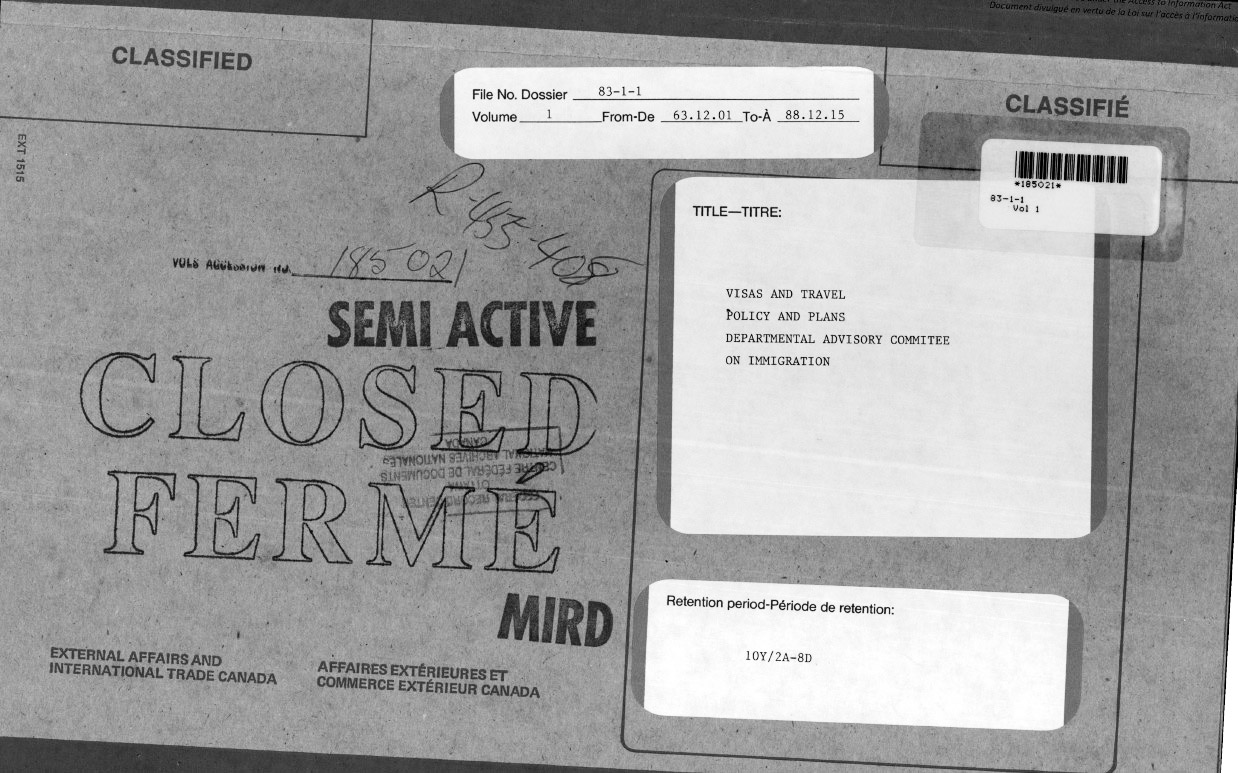
Immigration Policy and Programmes – Memorandum to Cabinet, 1964
“In this memorandum a statement of immigration policy during the coming year is put forward for approval. New difficulties and new opportunities are being encountered. Some established concepts are being modified by requirements at home and by changing circumstances overseas. Initiatives are being considered on the basis of two main objectives, namely, to stimulate economic growth and to reduce discrimination based on ethnic origin or creed as expressed in the sponsorship rights of Canadian citizens.“
The evolution of Canada’s immigration policy—and its programs—has had several inflection points. In 1962, the then-Minister of Citizenship and Immigration, Ellen Fairclough, had successfully championed regulatory change that—in theory, if not in practice—opened the possibility of skilled immigration to anyone in the world who could qualify. Though her government was unable to garner sufficient political will to introduce a new immigration act, these regulations were an important step towards a more non-discriminatory immigration selection regime.
In April 1963, George Diefenbaker’s Progressive Conservative government was defeated by the Liberals under the leadership of Lester Pearson, albeit with a minority. In the subsequent Speech From the Throne, delivered on May 16, the only mention of the topic of immigration consisted of five words: “Immigration policy will be reviewed”.
At some point in 1963, mandarins in the immigration department—likely at the behest of Minister Guy Favreau—drafted the memorandum to cabinet reproduced below, which was presented to Cabinet by his successor (René Tremblay) on 20 February 1964 and discussed more substantively on 5 March. The document is a fascinating look at the state of thinking of the time, proposing a shift towards the idea that immigration of “the skilled and easily trainable” would be of economic benefit to the country.
The memorandum proposed that the government undertake a “vigorous recruitment program” for skilled workers, that an interdepartmental committee be established to “study absorptive capacity and immigration requirements”, that the provinces be engaged, that more effective methods of recruiting immigrants be considered, that other countries’ governments be approached, and that the system of travel subsidies be reviewed.
The memorandum also mentions improved training for overseas immigration officers, the consideration of Canada’s “responsibilities to the world community”, and the reunion of families.
Finally, the document also raises the idea of a new immigration act to replace the 1952 iteration. While the optimism was there, it would be another twelve years before the Immigration Act, 1976 was tabled, and it did not take effect until 1978.
Primary documents such as this are a rich source of information and the CIHS strives to identify and preserve those that are available for easier access by the public and by researchers.
You can read the memorandum in the viewer below, or you may look at it in a new window.