
The 1975 Green Paper on Immigration and Population
(AKA the Canadian Immigration and Population Study)
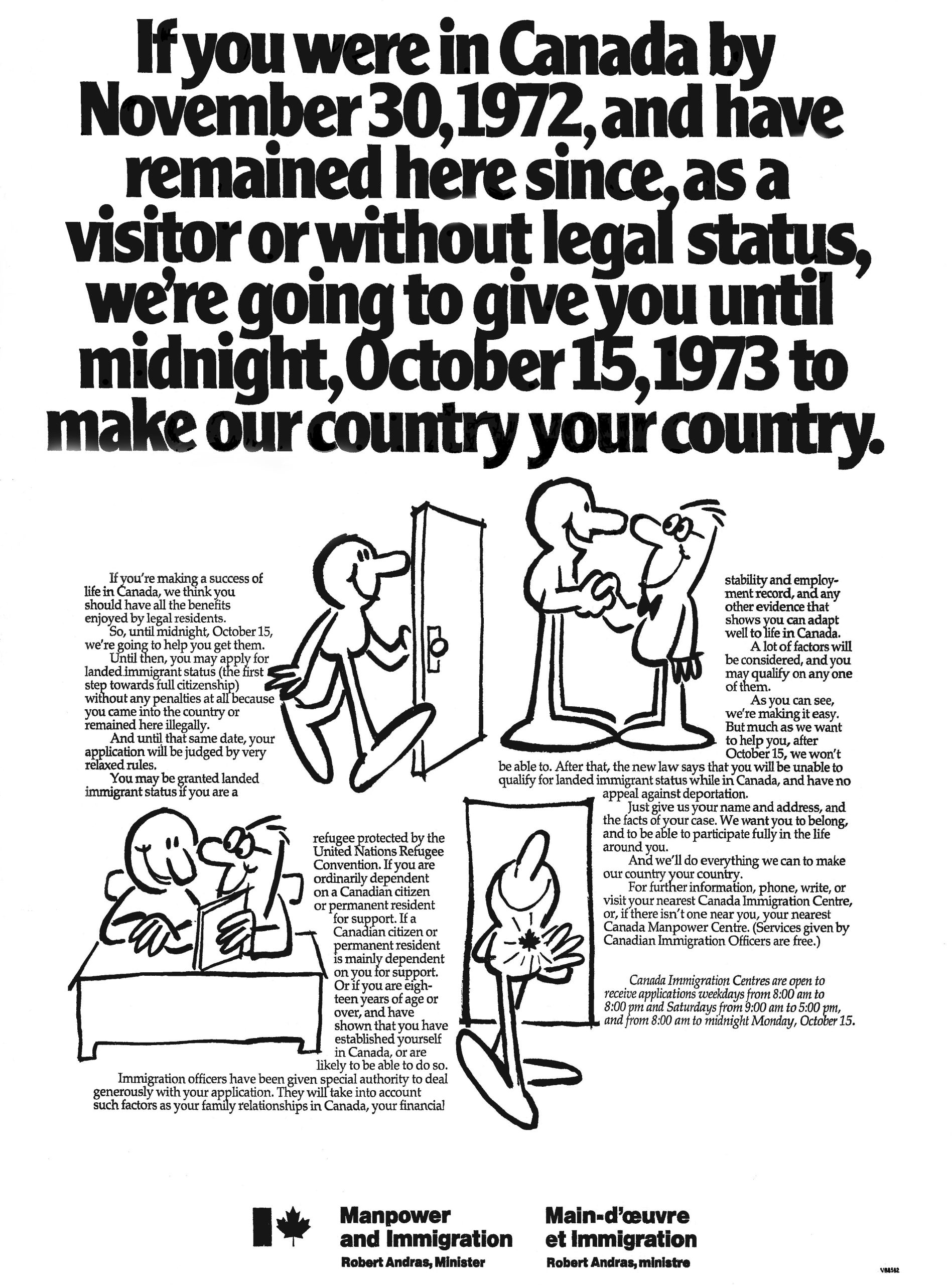
In September 1973, the Canadian Minister of Manpower and Immigration, Robert Andras, commissioned a study on immigration as a precursor to the development of legislation to replace the 1952 Immigration Act. At the same time, from August 1973 to October 1973, the government launched the Adjustment of Status Program, allowing undocumented individuals and visitors the possibility of regularizing their status under relaxed criteria.
In February 1975, the “Green Paper on Immigration and Population” was tabled in the House of Commons.
Unlike a White Paper (which typically signals the policy direction that a government intends to take), a Green Paper is intended to facilitate discussion and debate about what direction policy might take. While several governments in the 1960s and early 1970s had promised legislation to replace the out-of-date 1952 Act, none had made it onto the order paper.
The Green Paper actually consisted of four volumes prepared by a panel of academics and government officials:
- Immigration Policy Perpectives – this volume outlined the historical evolution of Canada’s immigration policy and examined the social, economic, and demographic factors connected to future national objectives.
- The Immigration Program – Volume 2 detailed the operational framework and procedures used to manage and process immigration to Canada, including the points system used to select independent immigrants.
- Immigration and Population Statistics – this volume contained a comprehensive statistical overview of historical trends, demographic projections, and the ethnocultural origins of immigrants coming to Canada.
- Three years in Canada – this was the first longitudnal report analyzing the economic and social adaptation of recent immigrants to Canadian society.
In addition, a slim volume entitled Highlights from the Green Paper on Immigration and Population served as a sort of executive summary of the entire report.
The Honourable Robert Andras tabled the Green Paper in the House of Commons on February 3, 1975. You can read the text of his speech to the House here (from Hansard).
We have posted selected media articles from the time that are useful in understanding the social and political context of the period. Note that these pages require a password as they contain copyrighted material.
Media related to immigration: 1972
Media related to immigration: 1973
Media related to immigration: 1974
Media related to immigration: 1975
Following the tabling of the Green Paper, a “Special Joint Committee of the Senate and of the House of Commons on Immigration Policy” held almost 50 public hearings in 21 cities across Canada. The Committee reported on these hearings in its Report to Parliament.
An interesting analysis of the Immigration Appeal Board was undertaken for the Law Reform Commission of Canada in 1976.