
Two sisters at the Canadian Embassy in Paris
Ms. Elvire Westley was a long time employee of the Canadian embassy in Paris – from the years immediately following the second world war until 1990. In 2017, she generously provided the CIHS with photos from her time in Paris, which were in turn donated to the Canadian Immigration Museum at Pier 21.
Her photo gallery can be viewed on our site as well.
Ms. Westley wrote this article for the CIHS Bulletin in 2017 (issue 83). The original is in French; what follows is a translation.
Two sisters at the Canadian Embassy in Paris
by Elvire Westley
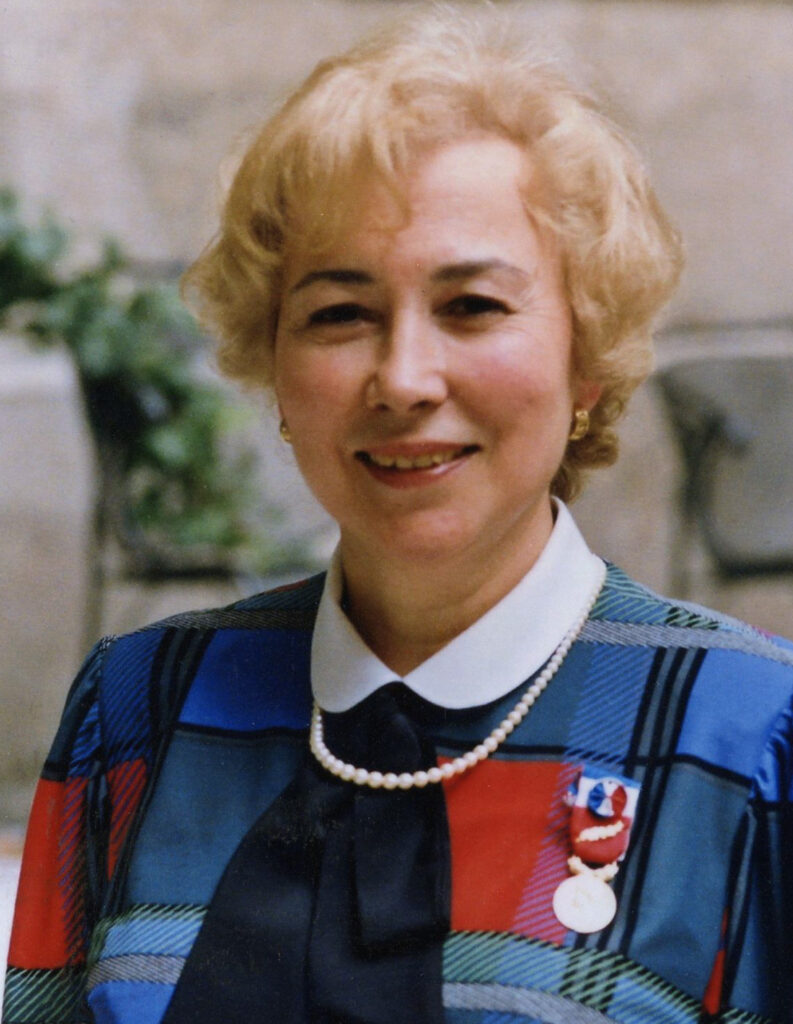
I was asked by Gerald Maffre, with whom I have corresponded for many years, if my sister, Jacqueline Westley, and myself, Elvire Westley, could put on paper our memoirs of the years spent shortly after the second world war at the Canadian Embassy in Paris, 13 years for Jacqueline, 42 years for me.
We took refuge in Great Britain during the war, our father being English. We were able to leave France with one of the last boats to leave the port of Bordeaux in June 1940, and we returned to France in November 1945. For the record, it took us five days to reach England to avoid the minefields.
When Jacqueline returned to France, she looked for work. An advertisement appeared in the British Chamber of Commerce newspaper to the effect that the Canadian Embassy was seeking the services of a bilingual secretary, and she presented herself and was hired in late 1946. The embassy was, at that time, located at 72 avenue Foch, and the residence on rue Dosne. Jacqueline started in the Personnel Department.
At the time, the secretaries took turns working on Saturday mornings. One of these mornings, when the ambassador, General Georges Vanier, was present, he asked for the secretary on duty, who happened to be Jacqueline. So she did the job and on Monday morning, the general asked her to join his department, where she stayed until she left, working for another ambassador before leaving the embassy to join the banking sector.
Jacqueline always considered it a great privilege to work for General Vanier, as well as to know Mrs. Vanier and several of their children, including Jean Vanier who created a Maison de l’Arche, not far from Paris, where we visited Mrs. Vanier when she lived with her son.
General Vanier was the first ambassador to be appointed to France after the war. As the longest-serving ambassador, he was called upon to receive personalities such as John XXIII, then Apostolic Nuncio in Paris, to whom he was very close, and to organize receptions such as the one given on the occasion of the visit to Paris at the time of Queen Elizabeth, still a princess, and her sister, Princess Margaret. Subsequently, the embassy moved to Avenue Montaigne where it is still located today (editor’s note: the embassy moved to a new location a few years after Ms. Westley wrote this article).

Canadian Embassy in Paris, circa 1948
In January 1948, I was hired by the Immigration Service of the embassy which had premises at 72 avenue Foch, but I started at 3 (if my memory serves me correctly) rue Scribe, to where the offices were moving, as a typist-switchboard operator. I still remember the old switchboard, which worked at the time with plugs and a crank! The name of my first boss was Monsieur Desjardins.
My first day gave me the chance to meet Madeleine Karp, a local activist like me, with whom I had a parallel career and who quickly became my best friend. She left us in 2013 and her friends still miss her. Two articles appeared about her after her death in the CHIC Bulletin (see Bulletin 69 and Bulletin 74).
I changed jobs when we were still at rue Scribe, working as a secretary in equal parts with Stage B, then directed by Mr. de Miffonis. From rue Scribe, we moved to 38 avenue de l’Opéra and then to 4 rue Ventadour (still in the Opéra district) and finally at avenue Montaigne.
I stayed with the Immigration Service, going from typist, to secretary, and then program assistant.
For a long time, I made the primary selection by way of the points system, which always seemed to me to be a very fair system for family reunification, job security, and refugees.
There was a time when our officers went on promotion trips to the various provinces of France, as well as to certain African countries for which we were responsible from the point of view of immigration to Canada. It was a lot of work, in addition to the various summonses or instructions to be given.
Our work also involved reporting and submitting files to Ottawa, as well as various offices across Canada, where not only did we have to type the cover letter but also copy the attachments. We didn’t have a photocopier! What a luxury when the first one arrived in Paris.
Then came the time when computers arrived in Paris. A team came from Canada to train us in this new technology, to which we adapted well but which could not compare to today’s technology.
A change also occurred when the Délégation Générale du Québec, the department dealing with immigration issues, took over the selection of immigrants for Quebec.
May I add here that meeting all these people from all walks of life, with the hope of going to Canada, was very enriching. I left the embassy in 1990 with regret because I had had the opportunity to do a job that interested me and that seemed useful, all while in a good atmosphere. Despite all of the work, we knew how to do poses like at the Christmas parties where we came in disguise.
Jacqueline and I have fond memories of our years at the Embassy. We have kept many contacts who are now friends.
Postscript
I would like to comment on the April 2017 French television program about the 100th anniversary of the Battle of Vimy Ridge, located in northern France, where many Canadians gave their lives.
General Georges Vanier spoke a lot about it to Jacqueline, who was his secretary in Paris for several years. He was with the Royal 22nd Regiment, of which he was so proud, on the battlefields near Vimy – and it was there that he lost part of one of his legs near the end of the 1914-1918 war.
We visited Vimy and were very impressed and moved by what we saw. The battlefields have remained as they are after all these years. It is impossible to remain indifferent when we still see the shell holes, the battle lines close to each other, and especially the cemeteries where we find the names and ages of all these young people who sacrificed their lives.
Editor’s Note: Elvire Westley bequeathed photographs illustrating her career to the CIHS. The entire collection can be found on the Society’s website. Any clarification regarding the persons in the photographs would be welcome at info@cihs-shic.ca.