The 1956 Hungarian Revolution and Canada
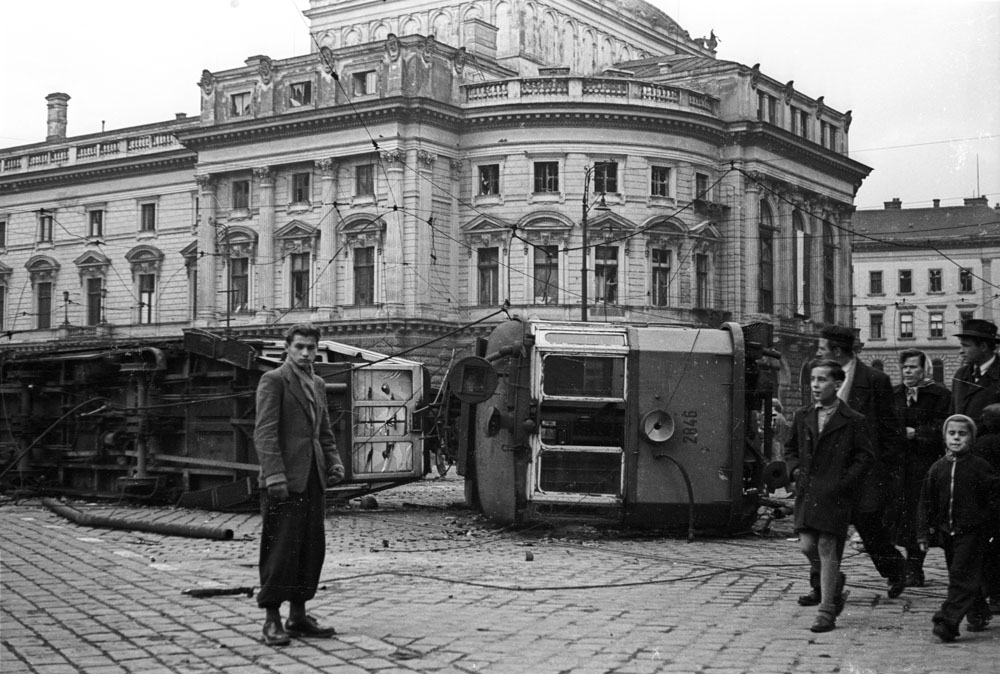
Above image: Young man in front of streetcars toppled during Hungarian Uprising in Budapest – Gabor Szilasi/Gabor Szilasi fonds/Library and Archives Canada/e011313451. Copyright: Gabor Szilasi.
October 23, 2026 marks the 70th anniversary of the beginning of the Hungarian Revolution of 1956—an event that led to over 37,500 refugees from that country being resettled in Canada. As the first such large-scale movement since the Second World War, it set a precedent for how Canada would respond to such crises in the future.
In the October 2006 edition of the CIHC Bulletin (number 49), a number of articles appeared in commemoration of that movement, which we are pleased to reproduce in their entirety.
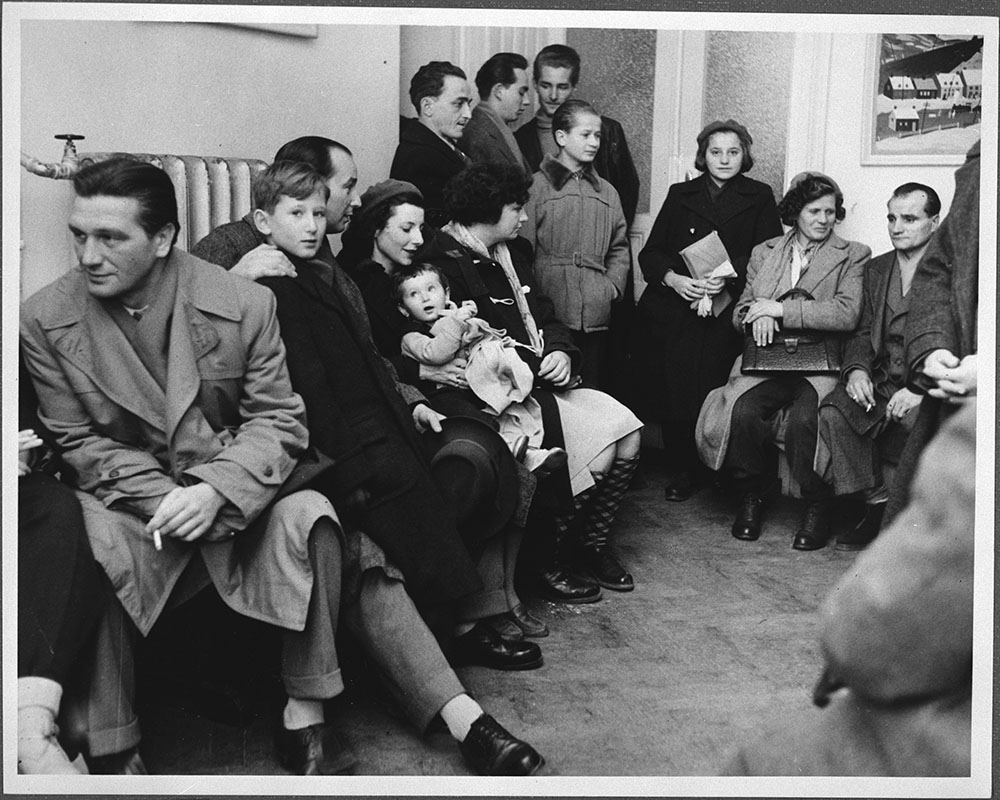
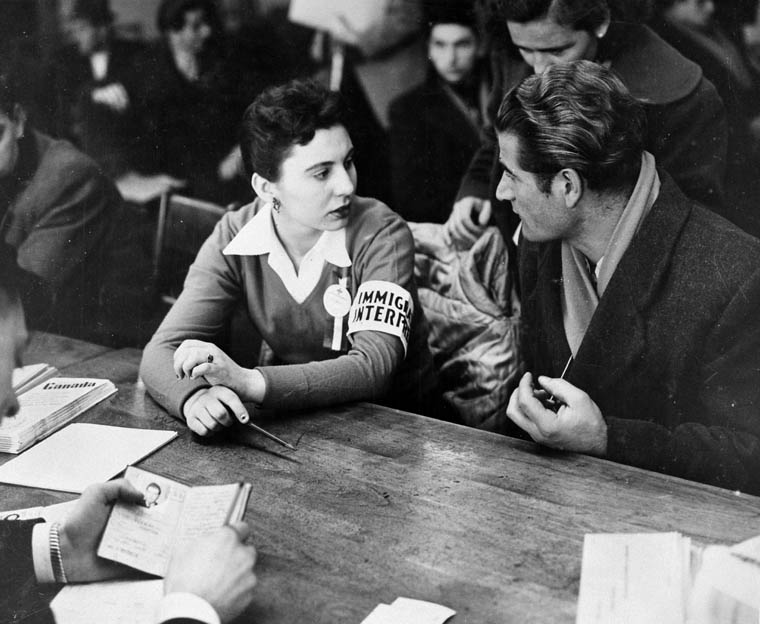
Interspersed among the articles are a number of visual records from Library and Archives Canada which document the movement.
The Significance of the Hungarian Refugee Movement
By Mike Molloy
The Hungarian Refugee Movement of 1956-7 is of historical significance as one of the largest single-source refugee resettlement programs ever undertaken by Canada with 37,566 persons admitted by December 1958.
Its significance goes beyond the mere number of people brought to Canada for resettlement as a result of the crushing of the Hungarian uprising. Of equal importance in terms of Canada’s future refugee policy was the precedent the movement set in establishing the idea that one of Canada’s roles in the second half of me 20th century would be to provide permanent resettlement for people displaced as a result of war, persecution, repression and other man-made crises. In the following decades the precedent set by the Hungarian movement pointed the way as subsequent displacements occurred (Czechoslovakian refugees in 1968, Ugandans in 1972, Chileans in the mid-70s, Boat People from Indochina in the late 1970s and 1980s, up to more recent groups like the Kosovars).
The Hungarian movement also demonstrated that ordinary Canadians would not only support government decisions to admit refugees in time of crisis but also that many of them would respond generously by contributing their time and money in assisting the newcomers to settle in.
The impact of the Hungarians on Canadian culture has received scant attention over the years but there are those who see them as the first critical ingredient in the transformation of dull old ‘Toronto the Good’ (and by extension many, many other Canadian communities) into the vibrant cosmopolitan city it would become in the sixties and beyond.
(Canada. Dept. of Manpower and Immigration / Library and Archives Canada / PA-181009)
The Movement of Hungarian Refugees to Canada
By Greg Chubak
This year [2006] marks the 50th Anniversary of the 1956 Hungarian Revolution and the subsequent refugee movement to Canada.
While there were prospects for enhanced global peace and security in early and mid-1956, the world remained fraught with Cold War tensions. The Suez Crisis was front-page news and the predominant global political concern at the time. Despite early cause for optimism, the October 1956 Revolution, led largely by students and intellectuals, ultimately failed. Within a period of weeks, the Revolution in Hungary was brutally crushed by Soviet troops. In short order the country produced more than 200,000 refugees (fewer than 2% of the total population), most of whom were seeking succour or resettlement from within Austria—although there were camps in Italy, the UK, France, and the Netherlands. This mass egress was despite obvious dangers, closed (or closing) borders, and long walks across vast expanses during a harsh central European Winter.
In Canada, the economy was robust, with economic growth building on post-WW II prosperity and the effects of the baby boom, the social climate was largely optimistic, and the government of the day was confidently facing an election (which it ultimately lost). It was this confluence of circumstances that led Canada, and the Immigration Service in particular, to facilitate the admission of almost 40,000 Hungarian refugees within less than a year. This process was perhaps spurred on by guilt for having remained, as per the Under-Secretary for External Affairs, ‘completely passive’ while the Revolution failed, combined with the prevailing Cold War ethos. In per capita terms, this was the most generous resettlement program of any of the major destination countries and was based on a recipe consisting of equal parts ideology and humanitarianism mixed with a liberal dose of good old-fashioned national self-interest.
While there remains some incertitude as to the genesis of the decision to accept a significant number of these refugees (within or without government), once it was made, the mobilization of resources was rapid. Notable was the active and enthusiastic leadership and participation by the Minister of Citizenship and Immigration, J.W. Pickersgill. Processing, from selection and screening in the camps in Austria through to landing in Canada, was extremely swift and involved a great deal of work and the creative application of the relevant policies. Given the proscriptions of the extant Act and the prevailing security (and anti-Semitic) concerns, it appears that Ministerial fiat was responsible for the ‘modified’ selection and admissibility criteria applied. Interestingly, there seemed to be no inter-party disagreement, and the entire movement was swept along in a deus-ex-machina manner without any formal direction or agreed-upon financial commitments by the government of the day. The process included providing transportation by air or sea to several Canadian ports of entry and destination cities and was notable in that it was not done on a cost recovery basis.
Settlement services and support upon arrival were provided, in many cases enthusiastically, by federal, provincial, and municipal governments, universities, as well as by charities and existing Hungarian communities in Canada. The most prominent and well-documented example of this support was the acceptance of the entire Sopron University of Forestry by the University of British Columbia. This group received a broad range of support which ultimately allowed them to graduate as a unit and with surprisingly little delay.
The group that left Hungary in 1956 was unique in its composition. The refugees were young (75% were younger than 35 and 50% below age 25), urban, educated (20% were still postsecondary students), and many were the educated elite with significant professional experience. Of these there was a significant percentage of Jews (reliable estimates indicate up to 20%) who saw little cause for optimism after the Holocaust. While the genesis of the refugee movement was the failed Revolution, the vast majority of those taking flight were not combatants but those who had some idea what might await them under continued Soviet occupation and a repressive Communist regime.
This group ultimately chose to settle in urban areas. In several cities they effectively doubled the Hungarian population. In Ottawa, they increased the existing Hungarian population by a factor of almost 10.
Given that this group was significantly different, especially with respect to ideology, from the two or three previous waves of Hungarian immigrants (the largely rural peasant groups that came between the 1880s and 1930, and the ‘DPs’ who came on the heels of WW II), they did not integrate well with them. As a result, this group tended to reject ethnic polarization and politicization with all its ‘isms’ and sought economic and personal advancement in the broader Canadian context. In this regard, members of this movement have excelled in, inter alia, the arts, media, business, engineering and the pure sciences. This group contributed greatly to the change in perception of the Hungarian community in Canada from stolidly rural and agrarian to urban and sophisticated.
While the circa 40,000 who came to Canada were not singularly responsible for the downfall of communism in 1989, it may be said that they constituted a significant catalyst for change. There may be no doubt that the efforts of this group in the years after the Revolution ensured that the eyes of the West were not averted from Hungary as they were in 1956.
From an Immigration perspective, the mobilization of resources and agencies and the underlying humanitarian and compassionate resettlement of this group became the template for dealing with subsequent refugee and migration and refugee challenges including the Czechoslovak, Ugandan Asian and Indochinese movements.
Despite a conclusion by some in External Affairs in 1957 “that the action of the UN on Hungary was largely a failure,” a corollary according to Minister Pickersgill’s reflection in later years may have been that “without any security clearances or most medical services, I think we got as fine a group of immigrants as ever came to Canada in the whole of our history”.
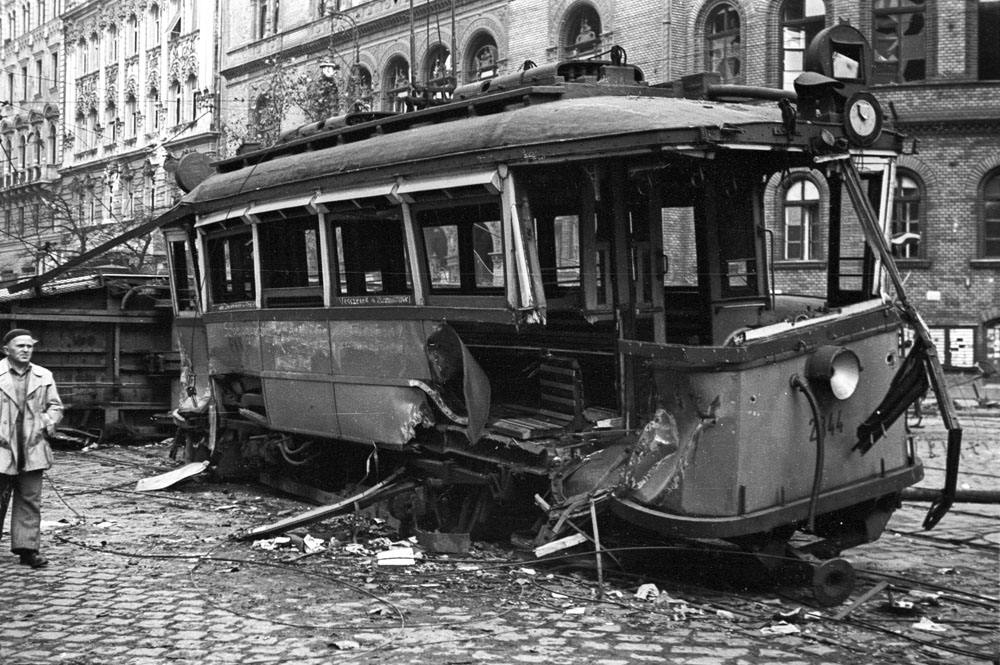
Credit: Gabor Szilasi / Library and Archives Canada / Gabor Szilasi fonds. Copyright : Gabor Szilasi
Budapest to Montreal 1956-1957, a Mini-Memoir
by Peter Duschinsky
The last time I saw the Budapest of my childhood, a line of Soviet tanks stood in the park, facing the tenement blocks in the outer district of Pest where my aunt Olga and uncle Joseph lived. The buildings bore scars of the heavy fighting of early November, when the lumbering behemoths encased in steel, that thirteen years before had faced Hitler’s panzers on the eastern front, rolled into Budapest and pulverized all in their path. The kids inside the tanks were terrified of the ‘fascists’ on the outside and shot at anything that moved. The kids on the outside, armed with handguns, rifles, the occasional Soviet machine pistol and Molotov cocktails consisting of bottles, rags and gasoline threw themselves at the tanks in acts of mad desperation. They fought out of frustration with the oppression, the poverty, the lies, out of a longing for something better than what they lived in, what they grew up in. Were they nationalists, socialists, democrats, fascists? Most fighters would not have been able to define what they were, they just knew instinctively that the time had come to fight, to make a stand even at the cost of their lives. Against the onslaught of the most powerful land army of the day, they fought and died in their tens of thousands. Others were caught and transported to disappear in the Gulag, never to resurface again.
During the revolt, I was a thirteen-year-old living in an orphanage in Old Buda. My mother, mortally ill with the heart disease that was to kill her in another few months, was in hospital in Pest. My father had been dead since 1942, before I was born, lost on the Eastern Front at the bend of the River Don, where the Romanian and Hungarian armies and their unarmed Jewish beasts of burden, serving as exposed labourers in the mine fields, were annihilated by the Red Army. My father had been one of those beasts of burden. The only proof of his death was a terse telegram my mother had received from the Red Cross.
I was thirteen, but I was precocious. Like a couple of other boys at the orphanage, I burned with impatience to be out in the street where things were happening, where heroes were fighting for our people. We stole supplies from the medical office and assembled a first aid kit. We snuck out with our first aid box to help the wounded fighters. In the cold wind of late October, we crossed the Danube in an open truck, the only transportation available at a time when there was no public transport, where everything, except the people’s collective will, had ground to a halt. Around us were young people, very young people. We may have been children, but we were the youngest by only a couple of years (A joke that made the rounds in Budapest after the Soviets had crushed the revolt: Question: “Why did the Russkies roll into Pest in the middle of the night?” Reply: “The children were asleep”). I witnessed the mob going wild in Republic Square, in front of Communist Party Headquarters where they dragged some State Police officers from the building and strung them up on trees. I was disgusted with the violence, especially that of the women, who appeared wilder, crazier than the men. I walked back to the orphanage through streets strewn with the debris of urban fighting, with the occasional corpse of a horse or a clog still lying on the ground amidst a chaos of cobblestones and downed electric wires.
Later I managed to get back to my godmother’s apartment in Pest where I saw my first Soviet soldier, who came to the cellar where we were hiding and told us that we could come out now, the fascists have been defeated. For the next six weeks the city subsisted in a state of suspended animation. No work, no school, no public transport, candles burning in apartment windows every night mourning the revolution’s defeat. There was enough food as the farmers managed to supply the city, but money was worth little and a lot of family heirlooms were being exchanged for sustenance. I sat in the dining room of my godmother’s apartment, playing cards with a new friend. The neighbouring apartment had an enormous hole in the bedroom where a wayward shell from a tank had hit.
As often as I could, I went to see my mother in the hospital. Over the weeks, as news of the open borders spread, people left Budapest by train, by truck, by any available means of locomotion, heading for the West. People-smuggling networks were established, rumours spread about who was leaving, about the best method for getting out. In the hospital my mother was burning with a strange determination, almost an obsession. She repeated, over and over, that I must leave Hungary, that nothing will ever be right here again. I cried and said that I would never leave her. She insisted: to me, to my godmother, and to my aunt Olga.
Olga made up her mind to emigrate on the spur of the moment. Conscious of my mother’s pleading, she told my godmother that she would take me, but I would need to get ready, all was arranged and the truck won’t wait. There was no solid reason for her to leave, except that her younger sister Elizabeth had left soon after the war and had been living for five years in Montreal with her husband, and her younger brother Ernest had also left with his family and was already in Austria. If Olga and her husband Joseph were to escape as well, only two very sick women of our family would be left alone in Budapest, my mother and my godmother.
So Olga left, leaving behind memories of wars and deaths and I went with her and Joseph. I felt terribly confused and guilty in leaving, but at the last moment I decided to go, with an old suitcase full of summer clothes and without any papers. Had I not left I would have betrayed the most ardent wish of my mother, but by leaving I left her to die alone. Within the next fifteen months both she and my godmother were in their graves. Of our large family, Hungarians on all sides as far back as we knew, not one person was left living in Hungary.
Fourteen people, including three family groups and two single young men, were in the back of the large canvas-covered truck. The two young men had pistols and, to everybody’s horror, stated that if we were stopped, they would fight; they would not go back to prison or worse. My uncle Joseph, who was originally from a small Transdanubian town, sat in the front with the driver, since both his accent and appearance lent a trace of legitimacy to our wandering in a truck through the back roads of the hill country. I had no idea where we were, but we kept on rolling, slowly and patiently, through the whole day. A drive that under normal conditions should have taken four hours took us ten, until seven o’clock that December night.
The driver and Joseph were sipping peasant wine and exchanging stories in the front, getting tipsy. Eventually this served us well, for in the early evening, already close to our destination, we were stopped by a patrol. Deathly silent in the back, we heard a patrolman ask, “where are you heading this late, don’t you know that this is restricted territory?”, and Joseph replied, “we’re off to a wedding”. “Some wedding you are going to”, said one of the patrolmen, “you’ve been into the sauce already, haven’t you? Go on, off with you and good luck.” Shortly after, we arrived at a farmhouse in the fields, where our guide was waiting.
We had a quick meal and then we were off, walking in silence in dark stubble fields covered by the first dusting of snow. In the distance we heard the insistent barking of village dogs. The moon, reflected by the snow, lighted our way. Close to our right, may be a half kilometre away, we saw lights behind a stand of trees and heard snatches of Russian singing, ” … kalinka, kalinka, kalinka maya … “. Those homesick Russian boys must also have been into the sauce, for there were no guards posted, nobody stopped us. I have heard that song many times—before and since—but will never forget that rendition. And then, seemingly only a short time later, although according to our watches we had been walking for two hours, our guide said, “this is it, you are in Austria. The village is down that way, just a ten-minute walk away.” The two boys with the guns fell down and kissed the ground. The rest of us headed to the village. I was lagging behind, my suitcase felt heavy. Walking along the main street, my aunt Olga stopped a well-dressed man and said something to him. He replied, took out his wallet and handed her a bill. I understood nothing. As we walked along, she explained, “I told him we were Hungarian refugees and asked him where we should go. He gave me this—she showed Joseph and me a 200 schilling note—and told me to go to that building beside the church.” She appeared dazed. We spent our first night in the West in a village hall sleeping in straw. The next day we took the train to Vienna.
Vienna is a fog in my consciousness. Very different from grey, dark Budapest, with neon lights, many cars, clean buildings, talk that sounded like gibberish. We went to some offices and registered with the Jewish Agency and when we said that we had family in Canada, we were told to fill out Canadian forms. We spent our nights in another big hall and were given food in a large cafeteria.
Then we were off to Salzburg, put up in a cheap hotel on the outskirts that was used to house Hungarian Jewish refugees. The three of us had a room and there was a shared bathroom in the hall. It was in that room that I began really to know Olga and Joseph, my new parents. They were a childless couple in their fifties. Olga spoke some German; Joseph spoke nothing but Hungarian—they had limited educations. Slowly they became aware of what they had done, leaving their home, their culture, everything they knew. Only decades later did I realize how scared they must have been, but they did not show it. Their simple courage and humanity animated their lives and everything they did, even when they suffered.
My mood alternated between enormous sadness over my dying mother and lost homeland, and total unrestrained joy. I wandered the hills of Salzburg, watched the skiers, the mountains, the snow, the clear blue skies. Never before had I seen anything as beautiful as winter in the Alps. We ate at the hotel with the other Hungarians, waited anxiously, impatiently for our papers for Canada, for our new lives. We made up outlandish hopeful stories about what was waiting for us. To understand this, we must recall that for Hungarians and even more for Hungarian Jews after the hell of the second world war, Canada was the mythic land of plenty. We knew nothing of Canada and were told little until we arrived, but we had hopeful myths and they kept us going.
Finally, the notice arrived that we were to do medical tests and we were given the fare to take the train again across Austria. It was back to Wiener Neustadt, not far from Vienna, a quick meeting with a Canadian official whose face and name are a blank after all these years and then, with our papers in hand, we reported to Vienna’s Western Station for the train trip to catch the boat sailing across the Atlantic from Liverpool to Saint John. Our trip through continental Europe was like a victory march. The train stopped in small and large Austrian and German stations and everywhere there were welcoming committees with flowers and songs and food and drinks. We crossed the Channel on the ferry from Oostende and finally hit total strangeness in Dover. Here the language was completely different, even more of a gibberish, people looked different, even the trains were different. And nobody cared that we were freedom fighters.
Crossing the Atlantic took six days. It was one of the last crossings for the “Empress of Britain”, an old dowager of the North Atlantic. She would soon be rendered unusable by jet planes making the trip in a few hours rather than a week. It was a stormy crossing in February. Olga was terribly seasick, she could neither eat nor drink, threw up constantly, stayed in bed in the cabin for the whole trip. Joseph and I ate in the ship’s dining room along with the other refugees and the paying passengers. The white tablecloths and linen napkins, the plethora of eating utensils, the strange exotic dishes with unaccustomed flavours, the buzz of low-key English conversation put us ill at ease in our threadbare clothes, looking and feeling like what we were, displaced refugees. To hide their embarrassment, their feelings of inferiority, some of the young freedom fighters, make believe studs in their late teens and early twenties travelling alone in the world, made up outlandish obscene rhymes in Hungarian, making fun of the strange English sounds around them. They also made up improbable lies about the voracious sexual appetites of the beautiful young English, Canadian and American girls on the boat.
And then we were in Saint John. We arrived in the early afternoon and were greeted by a welcoming committee. A middle-aged lady made a speech in Hungarian, explaining that she was welcoming us on behalf of Canada and the Department of Citizenship and Immigration. Her Hungarian was stilted, full of English words and strange phrasings, difficult to understand. In the new world even our mother language sounded like gibberish. She told us about the Queen and the Dominion, democracy, our political rights, job opportunities and wages and what help we could expect. It sounded wonderful, but very strange. That night they put on a dance for us. There were soft drinks and flowers and a big sign saying, “Welcome Freedom Fighters”. There was a local band playing rock and roll songs and slow numbers and beautiful rosy cheeked girls purring the embarrassed young freedom fighters at ease, asking them to dance. Everything was friendly and optimistic and magical, full of good feelings and hope in a new land. Who knows, maybe that night some of the young studs even struck it lucky.
Next day, it was back to reality. After a night spent in another dormitory, there was the long overnight train ride to Montreal through white fields and forests. We arrived at the old Windsor Station, where Aunt Elizabeth and Uncle Sandor met us. We took an enormous taxi to their apartment through the snowy dusk of a late winter afternoon. I sat in front, while they discussed things in muffled voices. Although I wasn’t meant to, I overheard Sandor whisper, “why did you have to bring him, things will be hard enough as it is” and Olga’s reply, “he’s a good boy, everything will be all right.” I was frightened and sad, lonely for my old home and missing my mother terribly. Yet I was also looking forward to the adventure of a new life in a new world, learning English and French and …. But that’s another story.
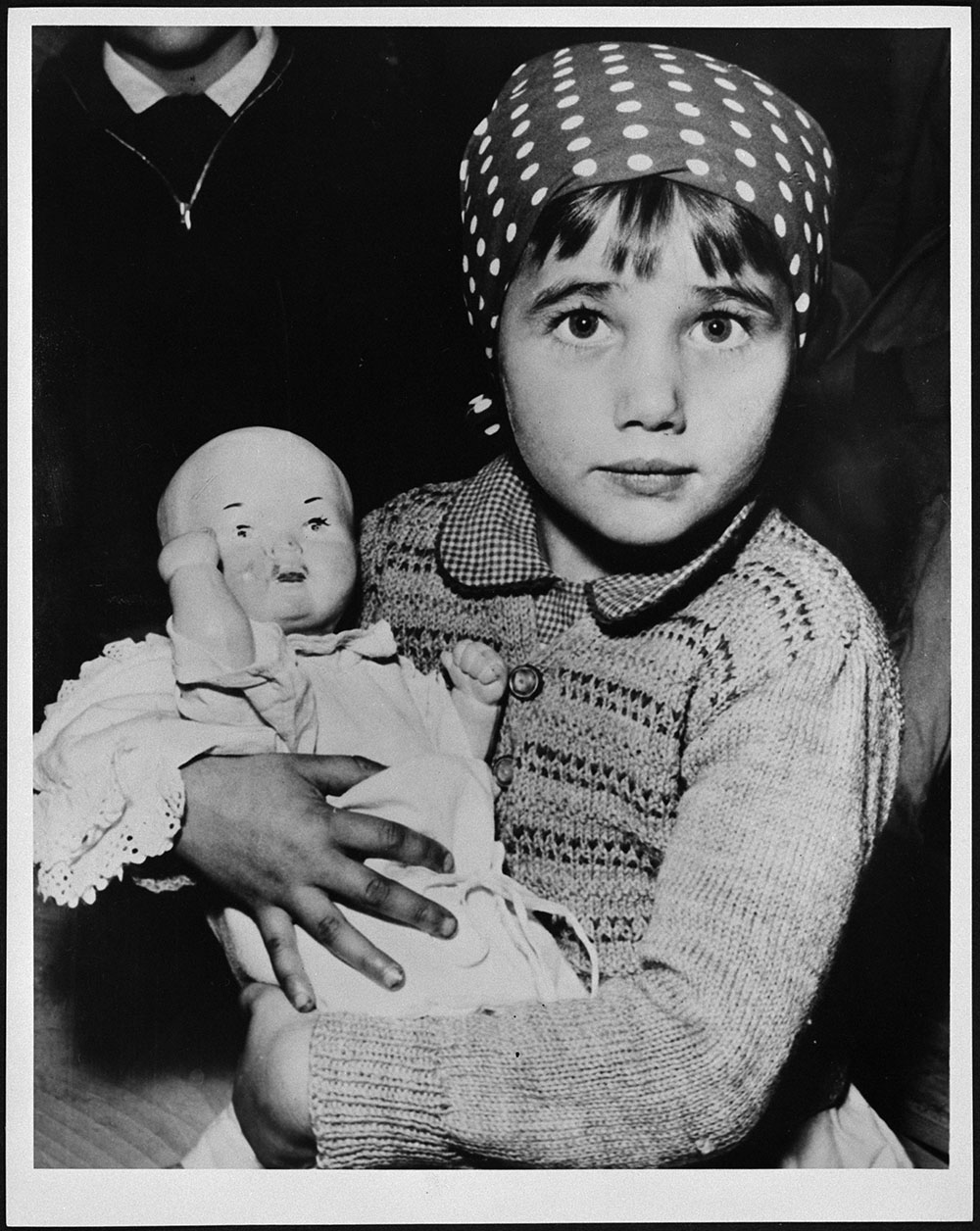
Credit: Star Weekly / Library and Archives Canada / PA-147723